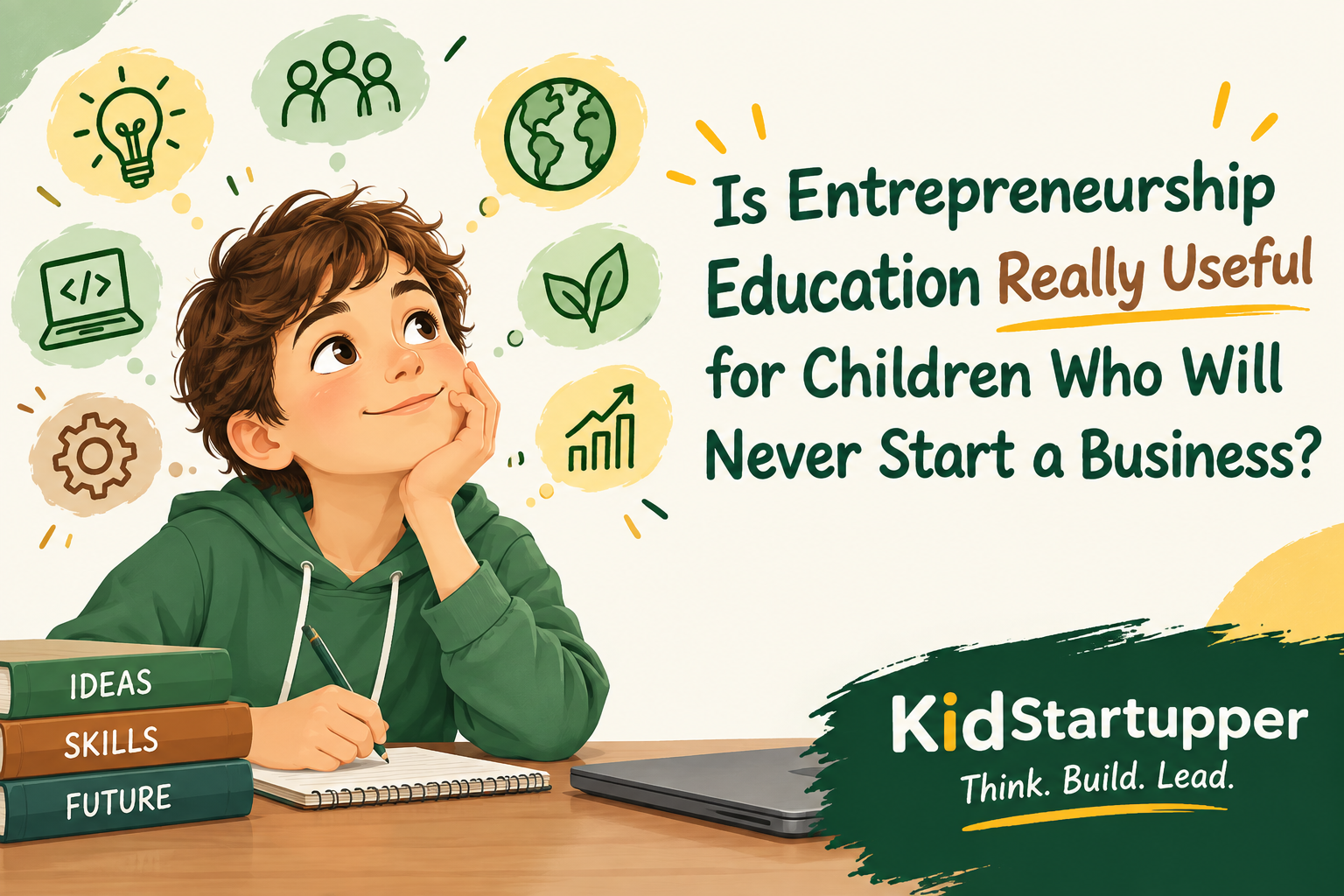

Is Entrepreneurship Education Really Useful for Children Who Will Never Start a Business?
This is the question I get asked most often by parents who are genuinely thinking carefully rather than just looking for permission to spend money on something.
It is a good question. And it deserves an honest answer rather than the predictable response — which is to reassure parents that entrepreneurship education is valuable for everyone, full stop, and leave it at that.
Here is my honest answer, after twenty years of working specifically with children on entrepreneurial thinking: the question itself contains an assumption worth examining. When parents ask "will my child start a business?", they are thinking about entrepreneurship as a career destination. I have come to think of it as something different — a specific set of cognitive and behavioural habits that develop through particular kinds of experience, and that turn out to be useful in almost every context a person eventually finds themselves in.
Whether those habits are worth developing in your child has very little to do with whether your child will ever found a company.
What I Actually Watch Happen in Children — and What It Has to Do With Business
Let me describe something I have observed hundreds of times, because the concrete reality is more persuasive than the abstract argument.
A child comes into one of our sessions. They are twelve years old. They are interested in marine biology — not business, not technology, not anything that sounds entrepreneurial in the conventional sense. They want to study oceans. They are already reading about it. That is what they care about.
We give them a challenge: identify a real problem in your local environment and think through how it could be addressed.
This child notices that the beach near her home has a persistent litter problem despite regular clean-up efforts. She starts asking questions. Why does the litter return so quickly after clean-ups? Who is producing it? Are there patterns — certain times, certain areas, certain types of waste? What have other communities tried? Why have those approaches worked or failed?
Over several sessions, she develops a concept for a community observation system — nothing technically sophisticated, but a genuinely thought-through approach to understanding the problem better before trying to solve it. She presents it. She handles questions from people who are sceptical. She adjusts her approach based on what she learns from those interactions.
At the end of that process, she has not started a business. She has not learned anything about profit margins or investor pitches. But she has developed something real: the experience of taking a problem seriously, thinking through it rigorously, communicating her thinking to a challenging audience, and adjusting based on what she learned.
She is now better at being a future marine biologist than she was before. Not because she learned marine biology, but because she practised the thinking process that makes any kind of serious intellectual work more productive.
That is what entrepreneurship education is actually developing. And it has almost nothing to do with whether a child will ever start a company.
The Specific Habits That Develop — and Why They Matter Across Every Career
I want to be precise about what I mean, because "transferable skills" has become such an overused phrase that it has nearly lost meaning. I am not talking about generic qualities like "communication" and "teamwork." I am talking about specific cognitive habits that develop through specific kinds of experience, and that most educational environments — including very good schools — do not deliberately cultivate.
Problem identification. The ability to look at a situation and articulate precisely what is not working, why it matters, and who it affects. This sounds straightforward. It is not. Most people — including most adults — are poor at it. They see symptoms without being able to identify the underlying structure. Children who practise this systematically develop analytical clarity that transfers across every domain. The future doctor who can identify what is actually wrong with a patient's situation before prescribing is practising exactly this skill. So is the engineer who can articulate what the real constraint is before designing a solution. So is the teacher who can identify what a struggling student actually needs rather than applying a generic intervention.
Decision-making under genuine uncertainty. Most school tasks have predetermined correct outcomes. Entrepreneurial problems do not. A child who regularly has to decide which approach to take when the right answer is not known — and then live with the consequences of that decision and learn from them — develops a relationship with uncertainty that most school environments never build. This capacity is relevant in every profession, in every leadership role, and in every significant personal decision a person will ever make.
The ability to communicate an idea to a genuinely uncertain audience. There is a meaningful difference between explaining something to a teacher who is obligated to listen and who has already decided to be supportive, and explaining something to people whose response is genuinely uncertain. The second experience develops communication in a way the first cannot. Children who regularly present to real audiences — who have to earn attention rather than be given it, who have to handle scepticism rather than encouragement — develop communication capacities that are genuinely rare and genuinely valuable.
Learning from failure productively. The relationship between failure and learning is one of the most consequential things a child can develop during the 10 to 15 age window. Children who learn to treat an unsuccessful attempt as information — to ask what it reveals about the problem, the approach, or the assumptions — rather than as verdict develop a fundamentally different relationship with difficulty. That relationship becomes more valuable, not less, as the stakes of the challenges they face increase.
Initiative. The disposition to move from "someone should do something about this" to "what could I do about this?" is not a personality trait. It is a habit that develops through repeated experience of being in situations where forward motion requires your own decision to begin. Children who develop this habit carry it into every professional context they enter — and employers across every industry consistently identify it as one of the qualities they value most and find hardest to hire for.
The Honest Limitation I Want to Name
I am not going to pretend that every child who goes through entrepreneurship education develops all of these capacities fully. The development depends significantly on the quality of the programme, the consistency of the engagement, and whether the child is in a period where they are genuinely ready to be challenged in this way.
I am also not going to claim that entrepreneurship education is the only way to develop these capacities. High-quality project-based learning in any domain can develop some of them. Sustained engagement with genuine creative work develops some of them. Meaningful responsibility for real outcomes develops some of them.
What entrepreneurship education does particularly well is combine all of these in a single coherent framework — one where the problem identification, ideation, decision-making, testing, communication, and iteration all connect as part of a single experience rather than appearing separately in disconnected contexts. That integration is what makes the development deeper and more transferable than if each element appeared in isolation.
What Parents Should Ask of Any Programme — Including Ours
The most important question is not "does this programme call itself entrepreneurship education?" It is: what does my child actually do in this programme, and what specific capacities does that develop?
If the honest answer is that children watch content about entrepreneurship, learn business vocabulary, and complete structured exercises with predetermined correct outcomes, the programme will not develop the habits I described above. It will produce familiarity with entrepreneurship as a topic. That is not the same thing.
If the honest answer is that children identify real problems, generate and evaluate possible approaches, develop and test concepts with genuine uncertainty about the outcome, communicate to audiences whose responses are not predetermined, and iterate based on what they learn — that programme is developing something real. The business framing is almost incidental. What matters is the experience of the full cycle.
At KidStartupper, our three-year home programme is built around Aristotle's First Principles method specifically because it trains children to reason from the ground up rather than by analogy to existing approaches. Every stage of the programme — from initial problem identification through development, testing, and presentation — is designed to develop the specific capacities I described above, with difficulty calibrated to remain productively challenging at each stage of development.
We offer a seven-day free trial because we are confident that what parents observe in that first week will answer their questions more directly than anything I can write here.
A Direct Answer to the Direct Question
Is entrepreneurship education really useful for children who will never start a business?
Yes — with the same logic that answers "is learning to write really useful for children who will never become professional writers?" Writing develops thinking. It forces clarity, organisation, and the ability to communicate across distance. Those capacities are valuable regardless of whether a child ever writes professionally.
Entrepreneurship education develops a specific cluster of thinking and behavioural habits. Those habits — problem identification, decision-making under uncertainty, persuasive communication, productive response to failure, initiative — are valuable regardless of whether a child ever starts a company.
The marine biology student I described at the beginning did not become an entrepreneur. She became someone who could think more rigorously about problems, communicate more effectively about her ideas, and engage more productively with feedback and failure. Those capacities will serve her in marine biology, in research, in any leadership role she takes on, and in her personal life.
That is what the programme is actually for. The business framing is the context that makes the learning most naturally productive for children aged 10 to 15. It is not the destination.
If you want your child to develop these habits — in a structured programme designed specifically for ages 10 to 15, with a free seven-day trial and no commitment — I invite you to try KidStartupper and see what you observe.
start your child's free 7-day trial here — no commitment, no credit card required
Frequently Asked Questions
My child wants to be a doctor. How is entrepreneurship relevant?
More directly than most parents expect. Medicine increasingly requires physicians who can identify systemic problems in care delivery, generate and evaluate possible improvements, communicate effectively with patients and colleagues, make decisions under genuine uncertainty, and take initiative when existing protocols are insufficient. These are the capacities that entrepreneurship education develops. The most innovative and effective doctors I have encountered in my work with educational institutions are consistently those who approach medicine with an entrepreneurial orientation — not because they run businesses, but because they think like people who can identify and address problems rather than simply execute existing procedures.
My child is not interested in business at all. Will they be bored?
In a programme that is primarily about business content — vocabulary, case studies, market analysis — quite possibly yes. In a programme that is primarily about problem identification, creative development, and real-world testing, the business framing is usually secondary to whatever problem the child actually cares about. In our experience, children who are genuinely interested in science, the arts, technology, or social issues typically find that entrepreneurial thinking gives their existing interests a new dimension rather than competing with them. The child who is passionate about environmental issues engages with entrepreneurship through environmental problems. The child who loves technology engages through questions about what technology should actually be built and for whom. The business framework is a vehicle, not the destination.
How is this different from what my child gets in school?
The core difference is in the nature of the problems. School, even very good school, primarily presents children with defined problems with known correct outcomes. Entrepreneurship education presents children with undefined problems where the right approach is genuinely uncertain and their thinking determines the direction. Both types of experience are valuable. But the second type — which is almost entirely absent from conventional schooling — develops the specific capacities that matter most in adult professional and personal life. It is not a replacement for what school provides. It develops what school, by its nature, cannot.
You may also find these articles helpful:
is an entrepreneurship course worth it for a 10-year-old?
what does a child actually learn in an entrepreneurship program?
most schools still train employees, not entrepreneurs