Nobody can give your child this certificate.
They have to build something first.
Most certificates say a child attended. This one says they created a business, wrote a plan, and stood up to defend it in front of people.
That is a different kind of document entirely — and both your child and the people who read it will know the difference.

Three things this certificate proves
Not attendance. Not effort. Evidence.
They built a real business
Named it, branded it, published a live page, worked out who the customer was and what to charge. Not a worksheet about business — an actual one.
They wrote a full business plan
A complete written plan by the end of Year 3. Most adults never produce one. Your thirteen-year-old will have.
They pitched it out loud
Stood up, presented what they built, and answered questions about it. The single hardest thing on this list, and the one that changes them most.
Your child has a drawer full of certificates
that mean nothing.
Swimming. Attendance. Reading week. Sports day. Every one of them was handed over because a child turned up, and every one of them is worth exactly what it cost to earn.
Children know the difference. They can tell instantly whether something was given to them or achieved by them — and they only value the second kind. So do universities. So does anyone reading a CV in ten years' time.
Given for turning up
- Awarded for attendance
- Everyone in the room gets one
- No evidence behind it
- The child knows it means nothing
- Goes in a drawer, stays there
Earned by building
- Awarded on completing the full programme
- Requires a finished business, plan and pitch
- Backed by work that exists and can be shown
- The child knows exactly what it cost them
- Goes on the wall — then on the CV
Four things your child has to do first
There is no shortcut and no partial award. The certificate is issued on completion of the full programme.
Complete every cycle of the curriculum
All lessons, all chapters, all quizzes across every cycle. Each cycle must be completed before the next one opens — there is no skipping ahead.
Build and publish their business
A named business with a live page inside the platform, a completed Business Model Canvas, and a clear answer to who the customer is and why they would pay.
Write a complete business plan
A full written plan covering the idea, the market, the model, the finances and the risks — written by them, not for them.
Present and defend it
Deliver the pitch and answer questions about their own business. In schools this happens at the annual Hackathon in front of an audience. This is the moment parents film.
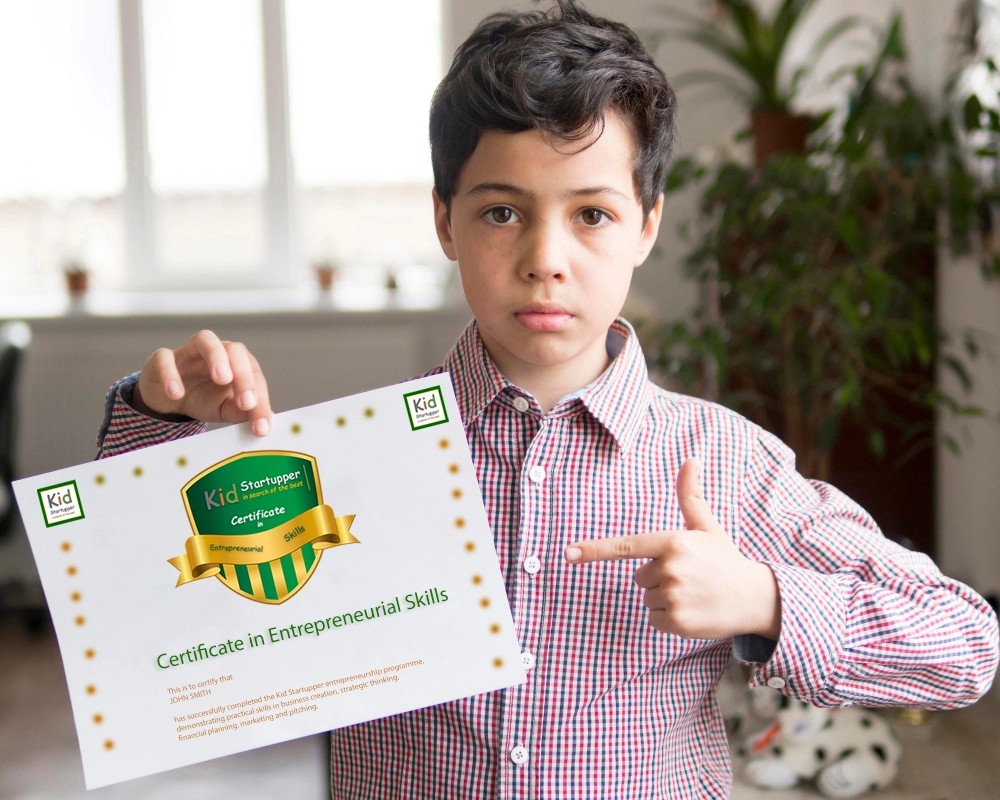
What the certificate confirms
The Certificate in Entrepreneurial Skills records the competencies your child demonstrated across the programme:
What the certificate says about your child
This is not an official accreditation and we would never claim it is. What it is is a concrete, shareable record of something real — and that is worth more than most certificates, because most certificates say nothing concrete at all.
They finished what they started
A multi-year programme with a real endpoint is unusual for a child. Completing it — all of it — is evidence of persistence that is harder to fake than a grade.
They built something, not just studied something
The certificate is backed by a business that exists inside the platform, a plan they wrote, and a pitch they delivered. Anyone who asks can see the work.
They can think independently
The Business Model Canvas, the customer analysis, the First Principles reasoning — none of it was done for them. The certificate confirms they worked it out themselves.
They took initiative voluntarily
Nobody at school required this. A child who chose to build a business on top of everything else is telling you something about who they are — and the certificate makes that visible.
The certificate is not the reward. It is the receipt.
The real thing your child walks away with cannot be printed: the settled, evidence-backed belief that they are someone who can build things.
They do not believe it because a parent told them. They do not believe it because they read it somewhere. They believe it because at twelve or thirteen they had an idea, built it, wrote the plan, stood up in front of people and defended it — and it worked.
The certificate simply proves it happened. The belief is what they carry.
What parents ask about the certificate
Answered directly.
It is an official Kid Startupper Certificate in Entrepreneurial Skills, issued by us and recording the competencies your child demonstrated. It is not a state or national qualification and we would never claim otherwise. Its value comes from what stands behind it — a completed three-year programme, a real business, a written plan and a delivered pitch.
No — and that is the point. The certificate is awarded on completion of the full programme, which means finishing every cycle, building the business, writing the plan and delivering the pitch. A certificate everyone receives is worth nothing to the child who receives it.
Home students receive the Certificate in Entrepreneurial Skills on completing all three core cycles. Students going through a partner school can continue into Cycles 4 and 5 — E-Commerce and Green Entrepreneurship — and receive additional recognition for those cycles, which are not available in the home programme.
Not in the traditional sense. Assessment happens continuously through quizzes built into the platform, and through the work itself — the business page, the Business Model Canvas, the business plan and the pitch. Your child is assessed on what they built, not on what they memorised.
Each cycle runs up to twelve months and children work at their own pace, particularly at home. If a cycle takes longer, that is entirely fine — the certificate is issued on completion, not on a deadline. We recommend enrolling as early as possible so there is comfortable time to finish all cycles.
The certificate is issued digitally so you can print it, frame it, or attach it to an application. If your child completes the programme through a school, many schools present it formally at their annual Hackathon or end-of-year event — which is usually the version families remember.
What admissions readers respond to is evidence, and this certificate comes with an unusual amount of it — a business your child built, a plan they wrote, a pitch they delivered. We would encourage your child to bring the work itself alongside the certificate. Together they are far more persuasive than either alone.
Learn it. Live it. Earn it.
In three years your child could be holding something almost no other fifteen-year-old has — and know exactly what it took to get there. It starts with one free trial.
No credit card · GDPR & COPPA compliant · Cancel any time · Or ask us a question first
What do they have to complete? See the full curriculum →
Who guides them through it? Meet Andrew, the AI companion →
How do I follow their progress? See progress tracking →
Our recognition and awards See awards & recognition →