
Is an Entrepreneurship Course Worth It for a 10-Year-Old?
Short answer: yes — but not for the reason most parents expect.
I get this question regularly from parents who are genuinely uncertain. Their child is ten. The word "entrepreneurship" makes them think of startup pitches, business plans, and adults making high-stakes financial decisions. The gap between that image and their ten-year-old feels enormous. So they ask: is this actually for my child?
I founded KidStartupper after more than twenty years working with children as a computer science teacher and education specialist. And my honest answer to that question is: it depends entirely on what the course is actually teaching.
A course that tries to teach ten-year-olds how to run a business is probably not worth it. Not because children cannot understand business concepts — many can — but because that is not the highest-value thing to teach a child at that age.
A course that teaches a ten-year-old how to think — how to notice problems, how to generate ideas, how to communicate those ideas to other people, how to make decisions and how to keep going when something is not working — is one of the most valuable things you can give a child at that age. Possibly at any age.
The question is which kind you are looking at. And how to tell the difference.
What Entrepreneurship Education for Children Actually Is — and Is Not
Entrepreneurship education for children aged 10 to 15 is not a miniaturised version of a business school curriculum. It should not involve corporate finance, formal accounting, or anything that simulates the administrative reality of running a company. Children who emerge from a course knowing how to write a business plan but not knowing how to think through a problem, communicate an idea clearly, or persist when something does not work have learned almost nothing of lasting value.
What genuine entrepreneurship education for this age group develops is a specific cluster of thinking and behavioural capacities that researchers consistently identify as predictive of long-term success — not just in business, but in virtually every professional and personal domain.
These include:
- Problem identification: the ability to look at a situation and notice what is not working, what is missing, or what could be significantly better
- Idea generation: the habit of moving from "this is a problem" to "here are some possible approaches" — producing options rather than waiting for someone else to produce them
- Critical evaluation: the ability to assess an idea honestly, identify its weaknesses, and improve it rather than simply defending it
- Communication: the ability to explain an idea to another person in a way that makes them understand and care about it
- Execution under uncertainty: the ability to begin working on something even when the path is not fully clear, and to adjust as you go
- Resilience: the practical experience of trying something that does not work and deciding what to do next, rather than treating the failure as a reason to stop
None of these are business skills in the narrow sense. They are human skills that entrepreneurial contexts develop with unusual effectiveness — because entrepreneurial contexts are inherently open-ended, inherently uncertain, and inherently dependent on the quality of the child's thinking rather than the accuracy of their recall.
Why 10 Is Actually an Ideal Age to Start
The research on this question is clearer than most parents realise.
The capacities most associated with entrepreneurial thinking — creative problem-solving, self-direction, tolerance for ambiguity, the disposition to try things rather than wait for instructions — are shaped significantly during the 10 to 15 age window. This is the period when children are developing the cognitive ability to think abstractly and hypothetically, to consider multiple perspectives simultaneously, and to plan and manage their own behaviour toward goals. These are exactly the cognitive tools that entrepreneurial thinking requires.
It is also the period, in my experience, when children are most receptive to developing these capacities in ways that stick. A fifteen-year-old who has spent five years developing strong entrepreneurial thinking habits has those habits substantially integrated into how they approach everything. A twenty-year-old trying to develop them for the first time is working against years of habits that point in a different direction.
Starting at ten is not too early. For many children, it is exactly right.
What a Good Course Actually Looks Like in Practice
Let me describe what a well-designed session with a ten-year-old looks like — because the description is more persuasive than any abstract argument.
A child is presented with a real problem. Not a textbook problem with a known solution, but a genuine open-ended challenge: something they have actually noticed in their school, their neighbourhood, or their daily life that does not work as well as it could. They are asked to define the problem precisely — which is harder than it sounds, and more important than most educational contexts recognise.
Then they generate approaches. Not one approach — multiple, including some that seem unlikely. They evaluate those approaches against specific criteria: Who would this actually help? What would it require? What could go wrong? Is there a version of this that could realistically be built or tested?
Then they work on communicating the idea. Not writing it down — explaining it to another person who does not already know about it, and watching what happens when the other person does not immediately understand. Adjusting. Trying again. Finding language that lands.
Then, depending on the programme and the idea, they work on testing some version of it — building a prototype, running a small experiment, presenting it to a genuine audience and handling the responses.
At every stage, the difficulty is real. The feedback is honest. The uncertainty is genuine. And the child is doing the thinking — not watching an adult do it, not filling in blanks in a worksheet, but actually exercising the capacities that the course is designed to develop.
That is what good entrepreneurship education for children looks like. It looks uncomfortable, productive, and alive. It does not look like school.
The Skills That Will Matter Most in the Next Twenty Years
I want to address the "why entrepreneurship specifically" question directly, because it is a fair one.
There are many things a ten-year-old could spend time learning. Music, languages, sport, coding, academic tutoring. All of these have value. Why entrepreneurship?
The honest answer is that entrepreneurship education, when it is well-designed, develops a specific set of capacities that most other childhood learning contexts do not — and that those capacities are becoming increasingly important relative to the capacities that traditional education does develop.
Artificial intelligence is accelerating the automation of routine cognitive work. The tasks that are hardest to automate — and therefore most valuable in a labour market shaped by AI — are tasks that require creativity, judgment, communication, adaptability, and the ability to work through genuinely open problems. These are precisely the capacities that entrepreneurial thinking develops.
A 2023 World Economic Forum report on the future of work identified creative thinking, analytical thinking, resilience, and complex problem-solving as the skills most likely to grow in value over the next five years. These are not abstract qualities. They are learnable skills. And entrepreneurship education, done well, develops all of them.
A child who spends the years from 10 to 15 developing strong entrepreneurial thinking is not just preparing for a possible future as a business owner. They are preparing for a future where the work that is most valued, most interesting, and most financially rewarding is the work that requires exactly what they have been practising.
The Specific Question Parents Should Ask Before Choosing a Programme
Not all entrepreneurship courses for children are created equal, and some are considerably less valuable than others. Before choosing a programme for your child, the questions worth asking are:
Is the learning active or passive? A programme built around lectures, videos, or worksheets about entrepreneurship is very different from one that puts children in situations where they have to think, decide, communicate, and adjust in real time. The latter develops capacity. The former mostly develops familiarity with vocabulary.
Are the challenges genuinely open-ended? The most important indicator of a well-designed programme is whether the problems children work on have genuinely uncertain solutions — where multiple approaches might work and the child's thinking determines the outcome — or whether they are effectively guided toward predetermined answers. Open-ended challenges develop judgment. Guided challenges mostly develop the appearance of it.
Is failure part of the process? A programme that is structured to ensure children always succeed is not developing resilience. It is developing a false sense of what building something actually involves. The best programmes create conditions where things sometimes do not work — and where children experience the specific process of working out what to do next.
Does the child produce something real? The most effective entrepreneurship education for this age group involves children creating and presenting something to a genuine audience — not just completing an assignment for a teacher. The experience of standing behind an idea in front of people who might not agree with it, and handling whatever response arrives, is one of the most developmentally significant things a child can do. It cannot be replicated in a classroom setting.
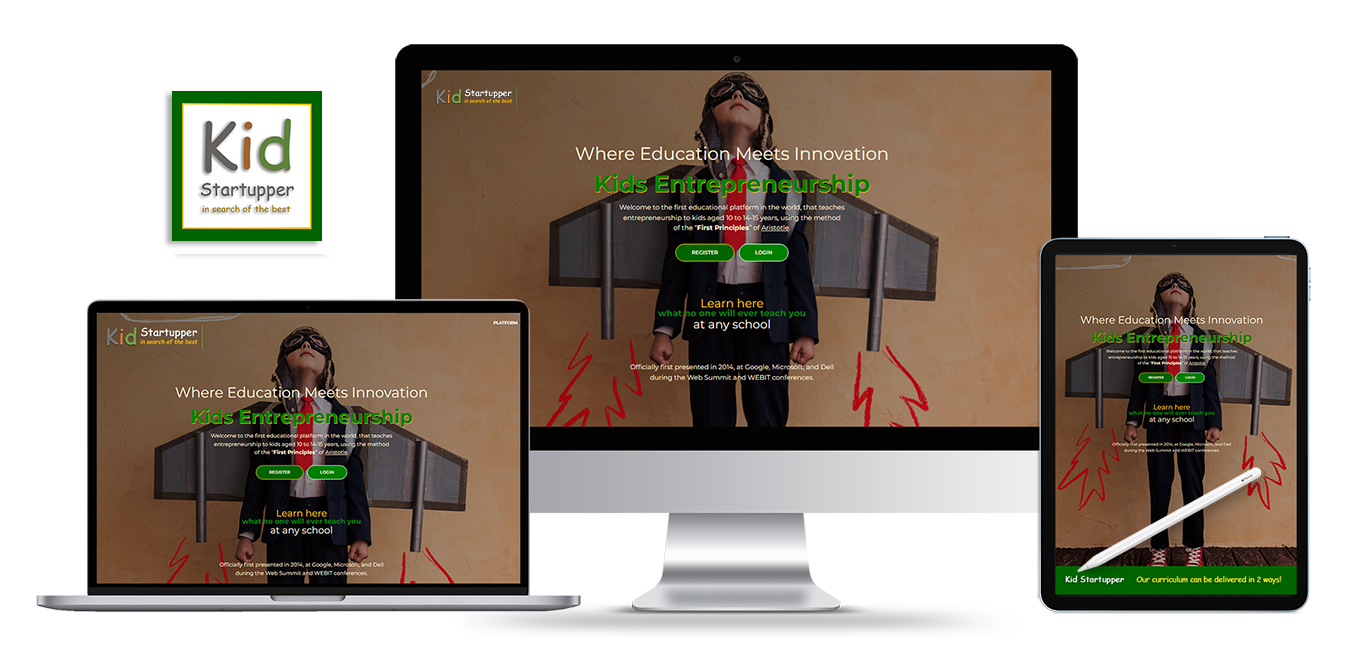
What KidStartupper Was Built to Do
I built KidStartupper around one central observation: that the skills most needed in the coming decades are being systematically underdeveloped in most children's education — not because schools are failing, but because schools were designed for a different set of priorities.
Our programme is built around Aristotle's First Principles method — a structured approach to thinking from the ground up rather than by analogy to what already exists. It is the same method that engineers, scientists, and innovators use to solve genuinely novel problems. Adapted for children aged 10 to 15, it develops the habit of asking: what do I actually know about this? What are the real constraints? What would I build if I started from scratch rather than from what already exists?
This approach, combined with project-based learning that involves real challenges and genuine audiences, produces children who can think, communicate, and create in ways that most educational programmes simply do not reach.
The programme has been recognised by Erasmus+, presented at Web Summit and Webit, and is used by schools and families across more than twenty countries. The recognition matters less than the reason for it: it works, in the specific sense that children who go through it develop capacities that are visible, durable, and genuinely useful.
Frequently Asked Questions
Is 10 too young to learn entrepreneurship?
No. Research on child cognitive development consistently shows that the 10 to 15 age range is an optimal window for developing the abstract thinking, self-direction, and creative problem-solving that entrepreneurial thinking requires. Children at this age are cognitively ready for genuinely open-ended challenges, and the habits formed during this period have lasting influence on how they approach difficulty throughout their lives. Starting at 10 is not too early — in many cases, it is exactly the right time.
Does my child need to want to start a business to benefit from this?
No. The vast majority of children who go through entrepreneurship education will not start businesses — and they do not need to for the education to be valuable. The capacities developed by good entrepreneurship education — creative problem-solving, communication, resilience, self-direction, the ability to work through genuinely open challenges — are useful in virtually every professional and personal context. A child who becomes a doctor, teacher, engineer, or artist will use every one of these skills throughout their career. The business context is a vehicle for developing them, not the destination.
How is this different from what my child learns at school?
Traditional education is primarily organised around defined problems with known solutions, where the student's job is to learn the correct approach and reproduce it accurately. Entrepreneurship education is organised around undefined problems with uncertain solutions, where the student's job is to figure out the approach themselves. Both are valuable. They develop different capacities. The specific capacities that entrepreneurship education develops — tolerance for ambiguity, self-direction, creative problem-solving, the ability to communicate and persuade — are rarely developed systematically in school settings, regardless of how good those schools are.
What results should I expect and over what timeframe?
The most significant changes tend to be visible within the first few months of consistent engagement, though they continue to develop significantly over a longer period. Parents most commonly report that children become more willing to attempt things they are not already good at, more persistent when something does not work immediately, more comfortable expressing and defending ideas, and more likely to approach problems with genuine curiosity rather than looking for someone else to provide the answer. These changes are not dramatic or sudden — they are gradual shifts in orientation that accumulate into something substantial over time.
How do I know if a programme is high quality?
The most reliable indicators: children are doing the thinking, not watching it being done. Challenges are genuinely open-ended. Failure is treated as part of the process, not something to be avoided or minimised. Children produce something real and present it to a genuine audience. The adults in the programme ask more questions than they provide answers. If a programme meets these criteria, it is almost certainly developing something valuable. If it does not, the most carefully designed curriculum will produce limited lasting benefit.
Final Thoughts
The question "is an entrepreneurship course worth it for a 10-year-old?" is ultimately a question about what you believe matters most in preparing a child for the life they are going to live.
If you believe the most important preparation is academic knowledge and the ability to perform well on defined assessments, then no — an entrepreneurship course is probably not the highest-value use of your child's time.
If you believe — as the research increasingly suggests, and as my twenty years of working with children have consistently shown — that the most important preparation is the ability to think creatively, communicate effectively, work through genuine difficulty, and keep going when things do not work out as planned, then a good entrepreneurship course is one of the most valuable things a 10-year-old can do.
Not because every child will start a company. Because every child will face a life that requires exactly these capacities — and because the window for developing them most effectively does not stay open forever.
If you want to see what this looks like for your child specifically, I invite you to try KidStartupper. The first seven days are free. What you see in that time — in how your child engages, what they produce, and how they talk about what they are working on — will tell you more than any description I can offer here.
start your child's free 7-day trial here
You may also find these articles helpful:
most schools still train employees, not entrepreneurs
school alone is no longer enough
the kids who will thrive in the AI era