
My Child Spends Hours on Screens But Won't Touch a Learning App. Here's Why — And What Actually Works.
Twenty years. That's how long I spent in school computer labs watching children interact with screens.
And in twenty years, one thing never changed.
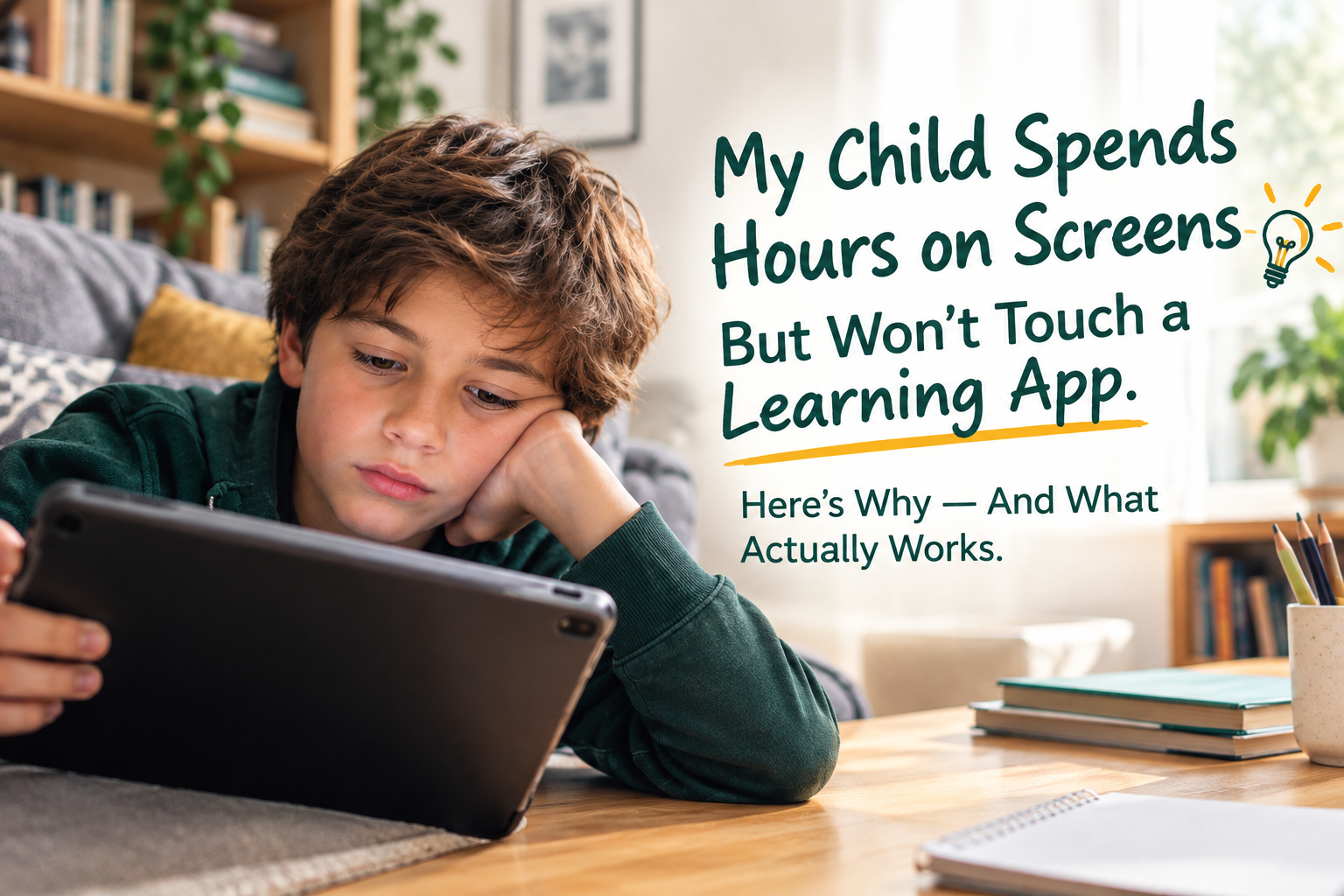
A child could sit in front of a tablet for three hours straight — clicking through a pointless app, replaying the same game level, watching videos that meant nothing — without ever once showing signs of tiredness. Eyes locked. Completely absorbed. You could call their name and get nothing back.
Then you'd open a learning application. Something genuinely useful. Something designed by smart people to teach them real skills. And within five minutes, the same child was yawning. Shifting in their seat. Asking when they could stop.
I watched this happen hundreds of times. And for a while, I blamed the children. Their attention spans. The generation. The phones. All the usual explanations.
Then I stopped blaming and started paying attention. Because something about this pattern didn't add up. These weren't children who couldn't focus. They'd just proven they could focus for hours. The issue wasn't the screen. It wasn't even the content. It was something else entirely.
The Real Reason Kids Shut Down on Learning Apps
Here's what I eventually understood, after enough time watching it play out in front of me.
When a child opens a game or a silly app, they are in control. Every tap, every swipe, every decision produces an immediate result. They're not being evaluated. There's no right answer they might get wrong. There's no effort that might not be good enough. There's just action and response, action and response, endlessly.
When a child opens a learning application, the dynamic flips completely. Now there's work to do. There's a correct answer somewhere and their job is to find it. There's a structure someone else designed and their job is to follow it. There's an implicit evaluation happening in the background — am I doing this right? am I good at this? — even when nobody is grading them out loud.
That shift — from player to student — is what kills the engagement. Not the screen. Not the topic. The relationship between the child and what they're being asked to do.
The child who seemed to have infinite energy five minutes ago suddenly needs a break because the energy was never about the screen. It was about being in control of something. The moment that control disappeared, so did the energy.
What I Saw Teachers Get Wrong — And Why
Over the years, I was invited to speak at schools about entrepreneurship education for children. Teachers who genuinely cared about their students. Smart, dedicated people who wanted to bring something new into their classrooms.
Almost all of them struggled. And the reason was almost always the same.
They had the concept. They had the enthusiasm. They had presentations about successful entrepreneurs, stories about people who started companies in their garages, case studies about products that changed the world. They stood in front of their students and talked about creativity, about thinking differently, about the future.
And the students sat there politely and waited for it to be over.
Not because the content was bad. Because the tool was missing.
Entrepreneurship — real entrepreneurship, the kind that means something — is not a subject you can teach by talking about it. You cannot tell a child what it feels like to create something from nothing. You cannot explain your way to the moment when a child looks at something they built and thinks: I made that, and other people want it.
That moment has to be experienced. And to experience it, you need something to build with.
Without the right tool, even the best teacher in the world is just adding another voice to the noise. Another adult telling children about a world they can't touch yet.
Entrepreneurship Is Not a Subject. It's a Creative Act.
This is the thing I wish more people understood about what we're actually doing when we teach entrepreneurship to children.
Think about what it means to paint a picture. You don't learn to paint by reading about painting. You don't develop an eye for color by memorizing color theory. You develop it by picking up a brush and making something — probably something imperfect — and then looking at it and deciding what to do differently next time.
Building something entrepreneurial is the same. It's a creative act. It has the same relationship to instruction that art has — you can talk around it forever and never quite capture what it actually is until someone puts the tools in your hands and lets you find out for yourself.
And here's what makes entrepreneurship specifically powerful for children aged 10 to 15: it asks them to create something that isn't just for themselves. It's not enough to make something you like. You have to make something other people want. Something they'll choose. Something they'll say yes to.
That requirement — to think about another person's experience, to care about whether your creation lands for someone else — is one of the most sophisticated cognitive and emotional challenges you can give a child. And it's also one of the most absorbing. Because it makes the work matter in a way that a worksheet never can.
When a child is working on something that other people will actually see and judge, the engagement is completely different. They're not doing it for a grade. They're doing it because they care what happens. That caring is the fuel that keeps them at the screen long after the novelty has worn off.
What KidStartupper Was Actually Built From
I didn't build this platform from theory. I built it from observation.
Twenty years of watching children in computer labs taught me one thing more clearly than anything else: children will do hard things for a long time if those hard things feel like play. And they will abandon easy things in minutes if those easy things feel like school.
The line between those two experiences is thinner than most educators realize. It's not about the difficulty of the content. It's about whether the child feels like a player or a student. Whether they're building something or filling something in. Whether their creativity is the engine or whether they're just executing someone else's instructions.
KidStartupper was designed around that line. Every element of the platform — the way challenges are framed, the way children move through the work, the way their output looks and feels — was built to keep the child on the player side of that line. Not because learning should always feel like play. But because entrepreneurship specifically is a form of creative play. It's a child saying: I see something that could exist, and I'm going to try to make it exist, and I want to know if other people think it's worth having.
That's not school. That's creation. And children who are given the right container for that kind of creation don't need to be motivated. They don't need to be pushed. They stay at the screen because they're not done yet.
The Shift I Watch Happen
I've seen it enough times now that I recognize the moment when it happens.
A child comes in skeptical. Maybe their parents enrolled them. Maybe they're used to entrepreneurship being something adults talk about in ways that have nothing to do with them. They sit down with the platform with the particular expression children wear when they've already decided something is going to be boring.
And then something in the first session catches them. Not always the same thing — sometimes it's the design element, sometimes it's the challenge of getting someone else to want what they made, sometimes it's just the experience of being asked what they think instead of what the answer is.
But something catches. And after that, something has shifted.
They're not consuming anymore. They're creating. And a child who has discovered what it feels like to create something that other people respond to — that child is not going to go back to three hours of pointless scrolling with the same ease they did before. Because they've found something that gives them more.
What Parents Can Do Right Now
You don't need to wait to start shifting your child's relationship with screens. Some practical things you can try today.
Pay attention to what they make, not what they consume. Most screen time is passive — watching, scrolling, reacting. The question worth asking is: is there anything your child makes on a screen? A video, a design, a game level, a document, anything? Creation is the signal. If it's not there, that's the gap to close.
Give them a creative challenge instead of a learning task. The difference between "watch this educational video about money" and "design something you could sell to kids your age and tell me why they'd buy it" is the difference between consuming and building. The second version is harder. It's also the one that keeps them at the table.
Let them show you something they made before you ask how they did on something they were graded on. This sounds small. It isn't. The child who regularly experiences adults being genuinely interested in their creations develops a different relationship with making things than the child whose performance is what gets the attention.
Stop trying to compete with the pointless apps. You won't win that competition on the apps' terms. The only way to win it is to give your child something that offers more than the apps do — real stakes, real creation, real response from real people. That's a different category of experience. And once a child has access to it, the pointless apps get less interesting on their own.
Frequently Asked Questions
My child loves Minecraft and says it's "creative." Isn't that enough?
Minecraft is genuinely creative, and I don't want to dismiss it. But there's a meaningful difference between building things inside a system someone else designed — with rules someone else set, in a world someone else imagined — and building something that has to work for real people in the real world. The second experience develops something the first doesn't: the ability to think about what other people want, to test your ideas against reality, and to iterate when reality pushes back. That's the specific capacity that entrepreneurial creation builds. Minecraft is a great starting point. It's not a destination.
My child isn't "creative." Will this still work for them?
In twenty years, I have never met a child who wasn't creative. I've met many children who had learned that their particular kind of creativity wasn't valued in the contexts they'd been placed in. The child who isn't creative with a paintbrush may be extraordinarily creative with a problem. The child who doesn't write stories may be brilliantly creative with systems and structures. Entrepreneurial creation is wide enough to include almost every form of creative thinking — because building something that other people want requires all of them.
How is KidStartupper different from other educational apps my child already ignores?
Most educational apps are designed to deliver content more engagingly. KidStartupper is designed to put children in the position of creator rather than consumer. The child isn't receiving information — they're making something. That's a fundamentally different experience, and it's the difference that determines whether a child stays engaged or finds an excuse to stop after five minutes.
Final Thoughts
The children I worked with in those computer labs over twenty years weren't failing to engage with their screens. They were engaging constantly — just not with the things we wanted them to engage with.
The lesson I took from all of that time isn't that screens are bad or that learning apps don't work. It's that children will give their full attention to something that makes them feel like a creator rather than a student. Something where their decisions matter. Something where other people's reactions to what they made tells them something real about what they're capable of.
That experience — of making something from nothing, and having it matter to someone else — is what entrepreneurship education at its best provides. And it's what KidStartupper was built to deliver, for children aged 10 to 15, in a format that competes with the pointless apps on their own terms and wins.
Not by being easier. By being more real.
The first seven days are completely free. No credit card required. See what your child does when the screen gives them something worth making.
Start your child's free 7-day trial here
You may also find these articles helpful:
What Do You Do With a Kid Who Gets Bored With Everything?
Why Boredom Is Actually Good for Children
AI for Kids: Tool or Substitute for Thinking?