
My Kid Wants to Start a Business. Now What?
A 12-year-old boy walked up to me at school one afternoon with a look I had never seen on him before.
Confident. A little nervous. Completely serious.
"I need to talk to you," he said. "I think I'm ready."
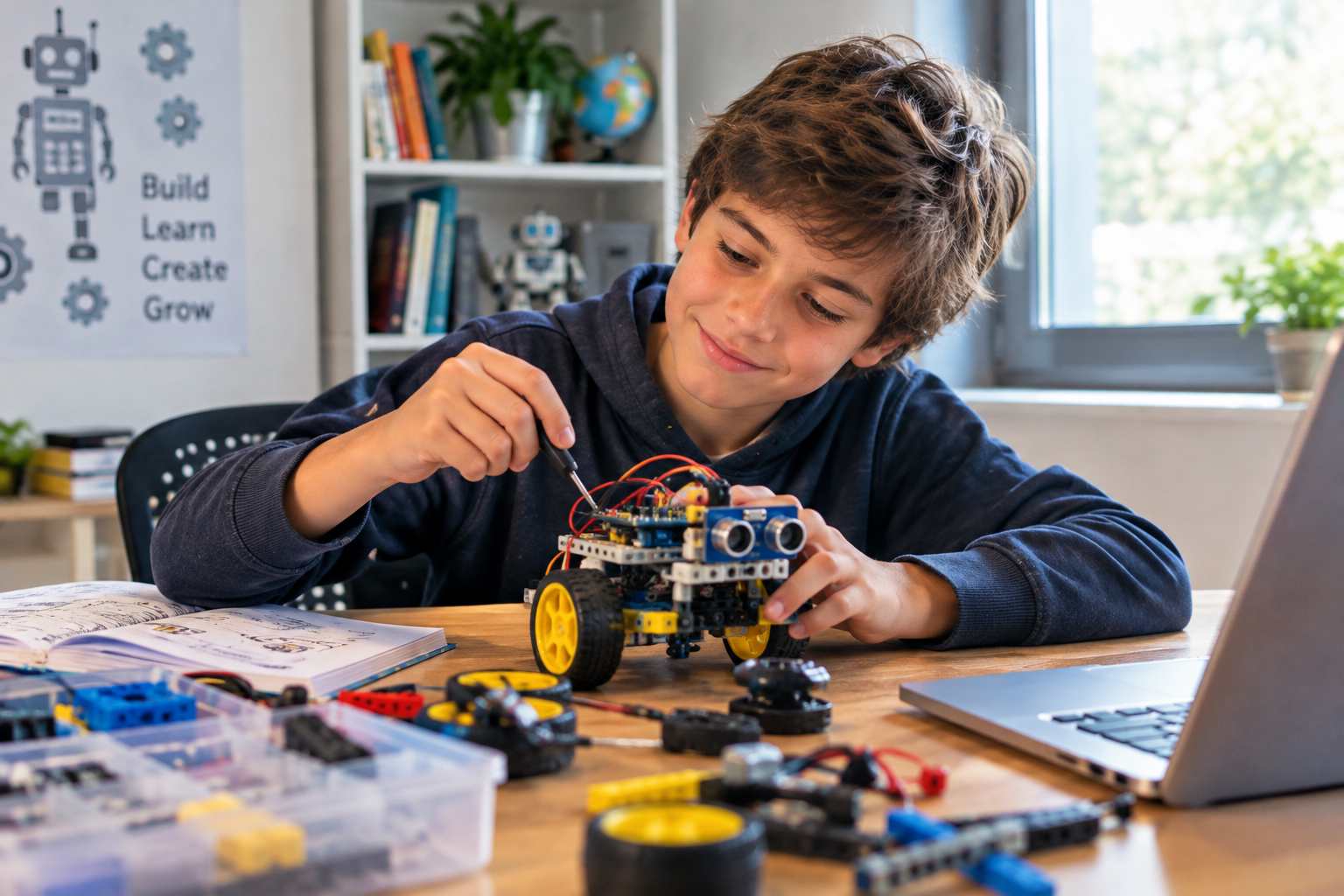
Over the next twenty minutes, he explained what he and his father had been building at home for the past several months. Robots. Four or five of them, each one programmed to do something specific. Using AI tools, his father's guidance, and more hours than either of them could probably count, this kid had figured out how to write code, load it onto hardware, and make things that actually worked.
Then he said something that stopped me.
"I can build any robot I want now and make it do whatever I need it to do. I'm ready to offer them to whoever wants one."
I asked him some questions. What did each robot do? How did he build them? What problems could they solve? His answers were clear, detailed, and genuinely impressive. This wasn't a hobby that had gotten out of hand. This was a child who had, without anyone planning it that way, developed a real skill and arrived at the edge of something meaningful.
And then came the sentence that told me everything I needed to know about what he actually needed.
"My problem, sir," he said, dropping his voice slightly, "is that I don't know what to do from here. And my dad doesn't know either."
That sentence is the reason I'm writing this article. Because that boy's situation — skilled, motivated, ready, and completely stuck at the edge of what's next — is more common than most parents realize. And the gap he was describing is exactly what entrepreneurship education exists to close.
The Moment Most Parents Miss
When a child comes to you and says they want to start something — a business, a project, a product, anything — the instinct is usually one of two things.
The first is enthusiasm. "That's amazing! Let's do it!" Which is wonderful, but doesn't actually answer the question of what to do next.
The second is caution. "That's great, but you're pretty young. Maybe when you're older." Which is understandable, but quietly communicates that the idea wasn't as serious as the child felt it was.
What most parents don't do — because nobody taught them to — is recognize that moment for what it actually is.
A child who has built something real and wants to know what to do with it has arrived at one of the most important developmental thresholds there is. They have moved past "I have an idea" and all the way to "I made something and I believe it has value." That is genuinely rare. Most people never get there at all, let alone at twelve.
What they need in that moment is not more encouragement. They need a framework. A way of thinking about what comes next. And that framework is exactly what most homes and most schools don't provide — because it's not academic knowledge. It's entrepreneurial thinking.
Why "Having a Great Idea" Is Only Half the Story
Here is the thing I've watched happen to children who create something impressive without the entrepreneurial layer to go with it.
They build. They produce. They're proud of what they made. And then — nothing happens. The robots sit on a shelf. The app gets abandoned. The product nobody knows about collects digital dust. And slowly, without anyone intending it, the child draws a conclusion.
Maybe it wasn't as good as I thought. Maybe nobody actually needs this. Maybe I'm not ready after all.
That conclusion is almost always wrong. But it's the natural result of having creative and technical ability without the knowledge of how to connect what you made to the people who need it.
That boy with the robots hadn't failed. He had succeeded, completely, at everything he set out to do. What he was missing was the next set of questions — the ones that turn a creation into something that matters to someone else.
Who actually needs a robot like this? What problem does it solve for them? How would you explain it to someone who has never seen it? How do you find those people? What do you say when you do? What do you do when they say no? What do you change when the first version doesn't land the way you expected?
These questions are not technical. They're not academic. They're entrepreneurial. And a child who learns to ask them — and work through the answers — has developed something that will serve them for the rest of their life, regardless of whether this particular idea ever goes anywhere.
What Children Actually Need When They're Ready to Build Something Real
I want to be precise about this, because I think it gets misunderstood.
When a child says they want to start a business, they don't need a business plan. They don't need a lecture on market research. They don't need a list of steps to follow.
What they need is the experience of thinking about their creation from someone else's perspective. Of asking not "what did I make?" but "what problem does this solve, and for whom?"
That shift — from creator to problem-solver — is one of the most significant cognitive moves a young person can make. And it requires a very specific kind of support to happen well.
When I sat down with that boy and started asking him questions, something changed almost immediately. Not in what he knew — his knowledge of the robots was exactly what it had been five minutes earlier. What changed was what he was thinking about.
Instead of describing what the robots did, he started thinking about who might need them. A younger kid who needed help with a school project. An elderly neighbor who couldn't bend down easily. A local store that needed something moved or sorted. These weren't fully formed ideas. But they were real. They came from him. And they connected what he had built to a world outside his bedroom.
That connection — between what you made and what someone else actually needs — is the heart of entrepreneurial thinking. And once a child experiences it, they never look at their own creations the same way again.
The Part That Matters More Than Money
I want to say something directly about what children this age are actually looking for when they want to share what they've built.
It isn't money. At twelve, thirteen, fourteen — money is abstract. It doesn't carry the emotional weight that adults assume it does. A child who sells a robot for twenty dollars doesn't feel the same thing as an adult who closes a deal. The transaction isn't the point.
What a child at this age is looking for — what they are genuinely hungry for, even if they can't name it — is recognition. Not praise from a parent or a teacher who is supposed to be encouraging. Recognition from someone who had a real problem, looked at what the child made, and said: this helps me. I needed this. You made something that matters.
That moment — when a person outside their family or classroom receives what they built and responds with genuine need — is one of the most powerful experiences a young person can have. It confirms something that no grade, no trophy, and no amount of parental encouragement can confirm: that their thinking, their effort, and their creation have value in the real world.
I've watched children change in that moment. Not dramatically. Quietly. Something settles in them. A confidence that isn't fragile because it isn't based on what someone thinks of them — it's based on what someone needed from them.
That experience is what entrepreneurship education is ultimately trying to create. Not businesses. Not profit. The experience of making something that matters to someone else, and knowing it.
Why Parents Can't Do This Alone — And Shouldn't Have To
The father of that boy with the robots was doing everything right. He spent time with his son. He supported the project. He helped him learn real skills. He was present in exactly the way we all hope parents will be.
And he still didn't know what came next. Not because he wasn't capable or caring enough. Because nobody had ever taught him this particular set of thinking tools either. This isn't knowledge that gets passed down automatically. It has to be deliberately learned — ideally in an environment designed to teach it.
What that boy needed wasn't more technical skill. He had plenty. What he needed was a structured way to think about who needs what he made, how to reach them, how to explain it in a way they could understand, and how to respond when the first attempt didn't work. He needed the experience of doing all of that, in a supported environment, enough times to develop the instinct for it.
That's what a well-designed entrepreneurship program for children provides. Not business theory. The actual experience of connecting a creation to a person who needs it — and everything that process requires you to figure out along the way.
What to Do This Week if Your Child Is Ready
If your child has come to you with something they've built — or with the energy and drive to build something — here's what I'd suggest.
Take it seriously before you do anything else. Not enthusiastically serious, where you get excited and project big futures onto a small idea. Genuinely serious — the way you'd treat the early stages of anything real. That means asking real questions, not rhetorical ones. What does it do? Who have you shown it to? What did they say?
Help them find someone outside the family to show it to. A neighbor. A teacher. A local business. Someone whose response isn't guaranteed to be positive. The experience of explaining what they made to a genuine stranger — and navigating whatever comes back — teaches more in one conversation than weeks of preparation could.
Ask the question they can't answer yet. "Who needs this the most?" Not as a challenge, but as a genuine invitation to think. That question — simple, unanswerable without real thought — is the beginning of entrepreneurial thinking. Let them sit with it. Don't provide the answer.
Don't rush toward revenue. At this age, the goal isn't income. It's experience. The child who figures out how to explain what they made, find someone who needs it, and handle the response — that child has learned something that will compound in value for decades. The child who skips all of that and goes straight to pricing has learned very little.
Frequently Asked Questions
My child has an idea but hasn't built anything yet. Is that still worth taking seriously?
Absolutely — and arguably it's the better starting point. A child with a strong idea and no product yet is a child whose first experience of entrepreneurial thinking will be building something for a purpose, rather than figuring out the purpose after the fact. Start with the questions: Who has this problem? What would actually solve it? What's the simplest version of that solution we could try? Those questions, worked through genuinely, will shape what gets built in a way that makes the eventual product much more likely to matter.
How do I know if my child's idea is actually good?
You probably can't evaluate it accurately — and that's not your job. Your job is to help them find out whether other people think so. The only opinion that matters, from an entrepreneurial standpoint, is whether the people who have the problem the idea is trying to solve find it useful. Get your child in front of those people as quickly as possible and let reality provide the feedback. That process — proposing, receiving a response, adjusting — is where the real learning is, regardless of whether the original idea turns out to be good or not.
My child gets discouraged easily when things don't work. Should I wait until they're more resilient?
I'd gently flip this around. Resilience in the face of setbacks doesn't develop by waiting for the right moment to face setbacks. It develops through facing them, in supported environments, enough times to discover that they're survivable. A child who gets discouraged easily needs more experience of things not working and continuing anyway — not less. The key is the quality of the support around them when it happens. A good entrepreneurship program creates exactly those conditions: real difficulty, in a safe enough environment that the child can keep going.
We tried helping our child with a business idea before and it fizzled out. How is this different?
Most children's business projects fizzle because they lack the one thing that keeps any project alive: a real connection to someone who genuinely needs what's being built. When a child is making something for an imaginary customer, or for a school assignment, the motivation dries up the moment the external pressure disappears. When they're making something for a real person with a real problem — and they've experienced that person's genuine response — the motivation comes from a completely different place. It doesn't require constant external maintenance. That's the difference entrepreneurship education is designed to create.
Final Thoughts
That boy with the robots eventually did show them to people outside his school. He didn't start a company. He didn't make money. What he did was walk into three different conversations with three different people, explain what he'd built, and listen to what they said.
One of them said: I could actually use something like this. Tell me more.
I wasn't there for that conversation. But I heard about it afterward. And I know from experience what that moment does to a child.
It tells them that what they made is real. That their thinking produced something the world has a use for. That the hours they spent building weren't just a way to pass time, but a step toward something that matters.
No grade produces that feeling. No trophy. No parent saying "I'm so proud of you."
Only someone who needed what you made, and told you so.
That experience is what we're trying to give every child who walks through KidStartupper. Not a business. Not a product. The knowledge — earned through real experience — that what they're capable of building has genuine value in the world.
If your child is ready to find that out, the first seven days are completely free. No credit card required.
Start your child's free 7-day trial here
You may also find these articles helpful:
My Child Has No Idea What They're Good At — And It Worries Me
My Kid Is Smart But Gets Nothing Done — Here's Why
How Do I Know If My Child Is Ready for Entrepreneurship?