
What Do You Do With a Kid Who Gets Bored With Everything?
I want to tell you about a student I had about ten years into my teaching career.
Bright kid. One of the sharpest thinkers I'd had in years. When we had open discussions, he was always three steps ahead of everyone else in the room. His ideas were original. His reasoning was fast. Other students looked to him instinctively when they needed someone to figure something out.
But the moment we moved from discussion to work — the moment I said "okay, now write it down" or "now complete the exercise" — he was gone. Not physically. He'd sit there. But the light went out. He'd produce the minimum required to avoid getting in trouble, and he'd spend the rest of the time staring out the window or doodling on the corner of his paper.
His parents were frustrated. His teachers were frustrated. Everyone agreed he had ability. Nobody could figure out why he refused to use it.
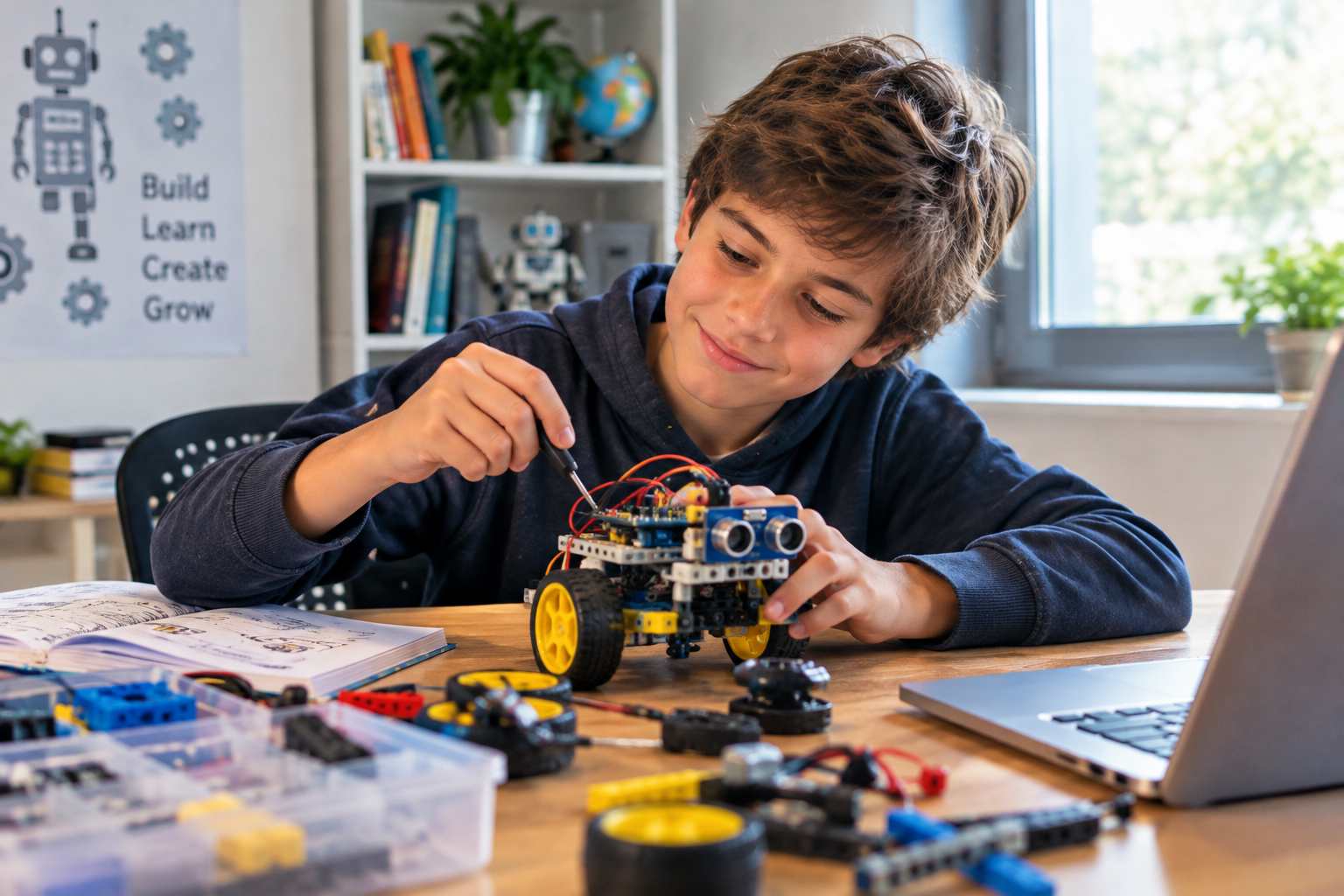
Then one day I brought in a design project. Instead of writing about a business concept on paper, students had to build it on screen — design the interface, map out the user flow, make it look like something real. It was the same intellectual challenge. Different medium. Different context.
That kid didn't look up for two hours straight. He produced the most detailed, creative work in the class. Other students were still on their first draft when he was already improving his third version.
I've thought about that afternoon many times since. Because what I saw wasn't a kid who suddenly got motivated. It was a kid who finally got the right container for something that had always been there.
That's what boredom almost always is in children who are clearly capable. Not absence of ability. Not laziness. Not attitude. It's a mismatch between what a child's mind needs and what they're being given to do with it.
What Boredom Actually Tells You
Parents usually experience their child's boredom as a behavioral problem. The eye-rolling. The "I don't care." The half-finished projects. The complete inability to sustain interest in anything for more than a few days.
After twenty years in the classroom, I experience it as information.
A child who is bored with everything is almost always a child whose mind is moving faster than the environment around them. They've already processed what's in front of them. They already know how it ends. The next twenty minutes of executing what's been defined feels pointless to them — because for their particular kind of mind, it is.
These children don't need less challenge. They need a different kind.
Specifically: they need challenges where the answer isn't already determined. Where the path isn't already marked. Where their thinking actually changes what happens. Because a mind that is genuinely engaged in figuring something out doesn't get bored. It gets absorbed. And there is a fundamental difference between those two states that I have watched play out in classrooms for two decades.
The Pattern I See Over and Over
Let me describe what this looks like, because I want you to recognize your own child in it.
The child who lights up in conversations but shuts down the moment it becomes an assignment. The child who has endless ideas but produces almost nothing finished. The child who is genuinely engaged for the first five minutes of any new thing and completely disengaged by minute fifteen. The child who seems to need the novelty of a new challenge to function — and loses interest the moment the challenge becomes routine.
What these children have in common is that their engagement is conditional. It switches on when something is genuinely open — when there's real thinking required, when the outcome isn't already determined. And it switches off when the task collapses into execution of something already figured out.
That's not a character flaw. That's a specific cognitive profile. And it tells you something important about what this child needs — and why the standard approach of pushing harder, setting more structure, and demanding more effort tends to produce more resistance rather than more engagement.
Why Telling Them to "Just Try Harder" Doesn't Work
I've watched parents and teachers try to solve boredom with pressure. More structure. Stricter deadlines. Rewards for finishing. Consequences for not engaging. Sometimes these approaches produce short-term compliance. They almost never produce genuine engagement.
Here's why.
A child who is bored isn't choosing to disengage as an act of defiance. They're responding to something real — the genuine absence of the kind of challenge their mind needs to function. Telling that child to try harder is like telling someone who's hungry to stop thinking about food. The instruction doesn't address the underlying condition.
What addresses the underlying condition is changing what they're being asked to do.
The same child who cannot sit through forty minutes of being told about entrepreneurship — listening to a businessperson talk about their journey, hearing about concepts that feel abstract and disconnected from anything they care about — is often the same child who will spend three uninterrupted hours building something on a platform where their decisions actually shape the outcome.
I've seen this happen enough times that I stopped being surprised by it. The engagement was always there. It was just waiting for the right trigger.
What Entrepreneurship Education Does That Other Approaches Don't
I want to be honest about something. When I first started teaching entrepreneurship to children, I thought the content was the point. The business concepts. The financial literacy. The vocabulary of startups and markets and customers.
I was wrong. Or rather, I was focused on the wrong thing.
The content matters. But what actually transforms the bored, disengaged child into someone who stays up late working on a project is something different. It's the experience of building something that is genuinely theirs. Of making decisions that actually determine what happens. Of seeing a problem and being given the tools — and the permission — to figure out what to do about it.
That experience works for bored children specifically because it gives their minds exactly what they've been missing: genuine open-endedness. There's no right answer to find. There's no template to follow. The quality of their thinking is the variable that determines the quality of the output. And a mind that's been starved of that kind of challenge responds to it the way that kid responded to the design project — by getting completely absorbed.
The Aristotle's First Principles method that underpins our program at KidStartupper works for exactly this reason. Instead of asking children to memorize and reproduce, it asks them to reason from the ground up. Why does this problem exist? What do we actually know about it? What would we build if we started from scratch instead of assuming the current solution is the only one?
Those questions don't bore children who are wired for deep thinking. They do the opposite.
The Difference Between a Child Who's Bored and a Child Who's Disengaged
I want to make one distinction that matters a lot in practice.
Boredom — the kind I've been describing — comes with frustration. The child is bored because they're not being given enough. Their mind is actively looking for more and not finding it. That frustration often shows up as irritability, as restlessness, as the kind of behavior that gets labeled as a problem when it's actually a symptom.
Disengagement is different. A disengaged child has stopped looking. They've learned not to expect anything interesting and have adapted to that expectation. They're not frustrated. They're flat. That's a more concerning pattern and usually requires more time and more consistent positive experience to reverse.
Most of the bored children I've worked with are in the first category. They haven't given up. They're still looking, still hoping something will engage them. The resistance they show is actually a form of energy — misdirected, but present. And misdirected energy is much easier to redirect than absence of energy.
If your child is in the first category — still frustrated, still reactive, still arguing about why things are pointless — that frustration is a good sign. It means there's something there to work with.
What Parents Can Do Right Now
You don't need to wait for a program to start shifting this. Some things you can do today.
Stop asking your child to complete things. Start asking them to build things. The difference sounds small. It isn't. "Complete this worksheet" and "figure out how you'd solve this problem" activate completely different kinds of engagement. Whenever you can replace completion with creation — even informally, even casually — do it.
Give them problems without answers. Real ones. What should we do about the fact that everyone in this family wants to do something different on Saturday? How could we make the morning routine less chaotic? These aren't school problems. They're thinking problems. And the child who can't sustain attention on a defined task will often engage with a real problem for much longer than you'd expect.
Let them choose the medium. One of the clearest things my years in the classroom taught me is that some children think better when they're building on screen than when they're writing on paper. Some think better when they're talking than when they're writing at all. The child who appears bored and incapable in one medium often appears completely different in another. Pay attention to where your child's thinking comes alive — and give them more of that context, not less.
Take their ideas seriously before you take them anywhere. The child who has ideas and sees them immediately evaluated — "that's interesting, but it would never work because..." — learns to stop having ideas. The child whose ideas are met with "how could we make that work?" learns to keep generating them. The question you respond to their ideas with is one of the most powerful variables you have access to.
Frequently Asked Questions
My child is bored at school but engaged with video games for hours. What does that mean?
It means their engagement capacity is completely intact. Video games are extraordinarily well-designed to provide exactly the conditions that engaged minds need: constant challenge calibrated to current ability, immediate feedback, genuine consequences for decisions, and the experience of getting better at something in real time. The child who is bored in a classroom and absorbed in a game isn't lazy — they're responding rationally to two very different environments. The question worth asking isn't "how do I get them off the game?" but "what is the game giving them that nothing else is?"
Is this giftedness?
Sometimes. But not always, and the label matters less than the pattern. Whether or not a child meets a formal definition of giftedness, the experience of being a fast processor in an environment designed for average pacing produces boredom. What those children need is the same regardless of the label: challenges that genuinely require their full thinking capacity, in contexts where their decisions actually matter.
My child gets bored with new things too, not just routine ones. What does that mean?
This is worth paying attention to. A child who gets bored even with novelty may be experiencing something beyond the mismatch I've been describing — anxiety, depression, or simply a developmental phase that will pass. It's worth a conversation with a professional if the pattern is pervasive and persistent. That said, I've also worked with children who appeared to get bored with everything and who came alive the moment they were given something that required genuine creative ownership. The specific context of entrepreneurial challenge is different from most novelty precisely because it doesn't wear off the same way — the problems stay genuinely open, and the child's thinking keeps genuinely mattering.
Final Thoughts
The student I described at the beginning of this article — the one who stared out the window until I gave him the design project — didn't become a different person that afternoon. He became more fully himself.
What changed was the container. The challenge finally matched what his mind needed to engage. And once that happened, there was no getting him to stop.
That's what I'm looking for every time I work with a child who is described as bored, disengaged, or unmotivated. Not a way to push them harder. A way to give them the right kind of challenge.
If you're raising that child — the one who has clearly got something but can't seem to find what unlocks it — entrepreneurship education designed specifically for their age and their way of thinking might be exactly that container.
The first seven days at KidStartupper are completely free. No credit card required. And what you'll see in that first week will tell you more than anything I can write here.
Start your child's free 7-day trial here
You may also find these articles helpful:
My Kid Is Smart But Gets Nothing Done — Here's Why
Why Boredom Is Actually Good for Children
Your Child Has 5 Years Left in the Window That Changes Everything