
How Kids Learn Resilience (And Why Some Children Give Up Too Easily)
There is a moment I have watched play out more times than I can count, and it always looks roughly the same. A child is working on something — a project, a drawing, a problem that will not resolve the way they expected. Something goes wrong. The work does not match the image they had in their head. A solution fails. A group member disagrees with their idea.
And then, in the space of about thirty seconds, they are done.
Not frustrated and pushing through. Not pausing to regroup. Done. Pencil down, chair back, eyes somewhere else. The decision to stop has been made before they have consciously made it, because the emotional experience of difficulty has become something to escape rather than something to move through.
What I have learned from watching this pattern over twenty years is that it almost never has anything to do with intelligence, or effort, or how much the child actually cares about the work. It has to do with whether the child has developed the emotional capacity to tolerate the discomfort that comes with genuine challenge — and whether that discomfort feels survivable, or whether it has always been removed before they found out.
Resilience is one of the most talked-about qualities in child development, and one of the least well understood. It is frequently reduced to a kind of toughness — a willingness to push through without complaint. But the children I have seen develop genuine resilience are not tough in that sense. They feel difficulty as acutely as anyone else. What they have is something different: a history of having moved through difficulty and arrived on the other side, enough times that they have some evidence — real, personal, experiential evidence — that they can do it again.
That evidence does not come from encouragement. It does not come from being told they are capable. It comes from experience. And experience of the right kind has to be created deliberately, because the environments many children grow up in today systematically remove it.
What Resilience Actually Is
Resilience is not the absence of struggle. It is not cheerfulness under pressure, or the ability to pretend things are fine when they are not. It is not toughness in the sense of suppressing emotion, or the determination to keep going no matter how much something hurts.
Resilience, at its most useful definition, is the capacity to move through difficulty without being permanently derailed by it. To experience failure, disappointment, frustration or setback — to feel all of that genuinely — and to continue. Not necessarily immediately. Not necessarily without distress. But eventually, and without the experience having destroyed your willingness to try again.
For children, this looks like many different things in practice:
- returning to a piece of work that did not go well the first time
- handling the emotional experience of being wrong in front of others
- continuing to engage with a group project after a disagreement
- tolerating the gap between what they imagined and what they produced
- recovering from a social conflict without it defining the rest of the day
- staying with a difficult problem long enough for something to shift
Resilient children are not children who do not struggle. They struggle just as much as anyone else. What develops, gradually and through accumulated experience, is the emotional capacity to stay in the struggle rather than flee from it. And that capacity is built — not found, not inherited, not given through praise — but genuinely built, one experience at a time.
Why Some Children Give Up So Quickly
Children who give up easily are almost never lazy. In my experience, the word lazy almost never accurately describes what is actually happening. What is happening is usually one of several things, and understanding which one matters — because the response that helps is completely different depending on the cause.
The most common pattern I see is what I would call difficulty intolerance: the child has learned, through repeated early experience, that the discomfort of not immediately succeeding is a signal to stop. Not a signal to try differently, or try harder, or wait. A signal to stop.
This often develops in children who have been protected from struggle — whose parents, with genuine love and good intentions, have consistently stepped in before the discomfort became too great. The problem is not the intention. The problem is that the child never develops the experience of moving through discomfort, because they are always carried past it. They reach difficulty and stop, not because they are incapable of what comes next, but because everything in their experience tells them that difficulty is the endpoint.
A second pattern is what the psychologist Carol Dweck's research has called a fixed mindset — the belief, usually unconscious, that ability is something you either have or do not have, rather than something that develops. Children with this belief face a particular problem when things get hard: struggling feels like evidence that they are not good enough. So they stop — not to avoid the work, but to protect their sense of themselves. If I do not try, I cannot prove I am incapable.
A third pattern, less discussed but very real, is sensitivity to social comparison. Some children give up not because they cannot tolerate their own difficulty, but because they cannot tolerate the experience of struggling while others appear not to. The visible ease of others — real or imagined — becomes unbearable, and withdrawal feels less painful than continuing.
Each of these patterns is learnable. None of them is permanent. But they each require something different, and treating them all as the same problem — a lack of effort, a lack of willpower — tends to make things worse rather than better.
A Story That Illustrates This Well
A few years ago I worked with a ten-year-old boy who was one of the most curious children I had encountered. He asked questions constantly, noticed things that other children walked past, and had a genuine appetite for ideas. In one-on-one conversation, he was extraordinary.
But in any group setting that involved producing something — a project, a presentation, a shared piece of work — he consistently disappeared. Not physically. He would sit at the table, participate in early discussion, and then gradually become less and less present until by the end he had contributed almost nothing to the actual output.
His parents described him as a perfectionist who gave up when things were not going perfectly. His teachers described him as inconsistent — brilliant in some moments, absent in others. Everyone agreed he had potential that was not being realised. Nobody had quite identified why.
When I eventually understood what was happening, it was simpler than any of those descriptions suggested. He had developed a very precise sense of how good his work was supposed to be — drawn from somewhere, probably from early praise about how bright he was — and when the work in progress fell short of that standard, which it always does in the middle of any real project, he experienced it as a kind of personal evidence that he was not as capable as everyone believed. The gap between the standard and the reality was not something he had learned to work through. It was something he had learned to avoid.
What helped him was not more encouragement. It was less — specifically, less praise about how talented he was, and more deliberate attention to the process of working through difficulty. We started noticing, out loud, the moments when something was hard and he stayed with it anyway. Not "you're so clever" but "you just kept going on that when it wasn't working — that's the part that actually matters." Slowly, his relationship with his own imperfect work-in-progress began to shift. He started to understand that the gap between the standard and the reality was not evidence of failure. It was evidence of being in the middle of something real.
What Modern Childhood Sometimes Gets Wrong About Resilience
There is a particular feature of many children's lives today that quietly works against the development of resilience, and it is worth naming directly: the systematic removal of productive discomfort.
Digital environments, in particular, are built around instant reward and frictionless experience. The gap between wanting something and getting it — which in previous generations could involve significant time, effort and uncertainty — has collapsed almost entirely for many children. Entertainment is available immediately. Information arrives without searching. Social feedback is constant and instant. Frustration is designed out of the experience wherever possible.
This is not a moral failing of technology. It is simply what these environments are optimised for. But the consequence for resilience development is significant: children who spend large portions of their time in frictionless environments lose practice in tolerating friction. And friction — in the form of delay, difficulty, failure and uncertainty — is exactly what resilience is built from.
The protective instinct of parents compounds this. It is one of the most natural things in the world to want to spare a child the experience of struggling, failing or being disappointed. But children who are consistently spared these experiences do not develop the emotional tools to handle them when they inevitably arrive. And they always arrive — in school, in friendships, in any endeavour that involves other people and real stakes.
The goal is not to expose children to unnecessary suffering. It is to allow them access to the kind of manageable, supported difficulty through which resilience actually grows. That distinction — between productive struggle and unnecessary harm — is the central judgment call of resilience-building parenting.
How Parents Can Build Resilience at Home
1. Let Difficulty Be Difficult Before You Intervene
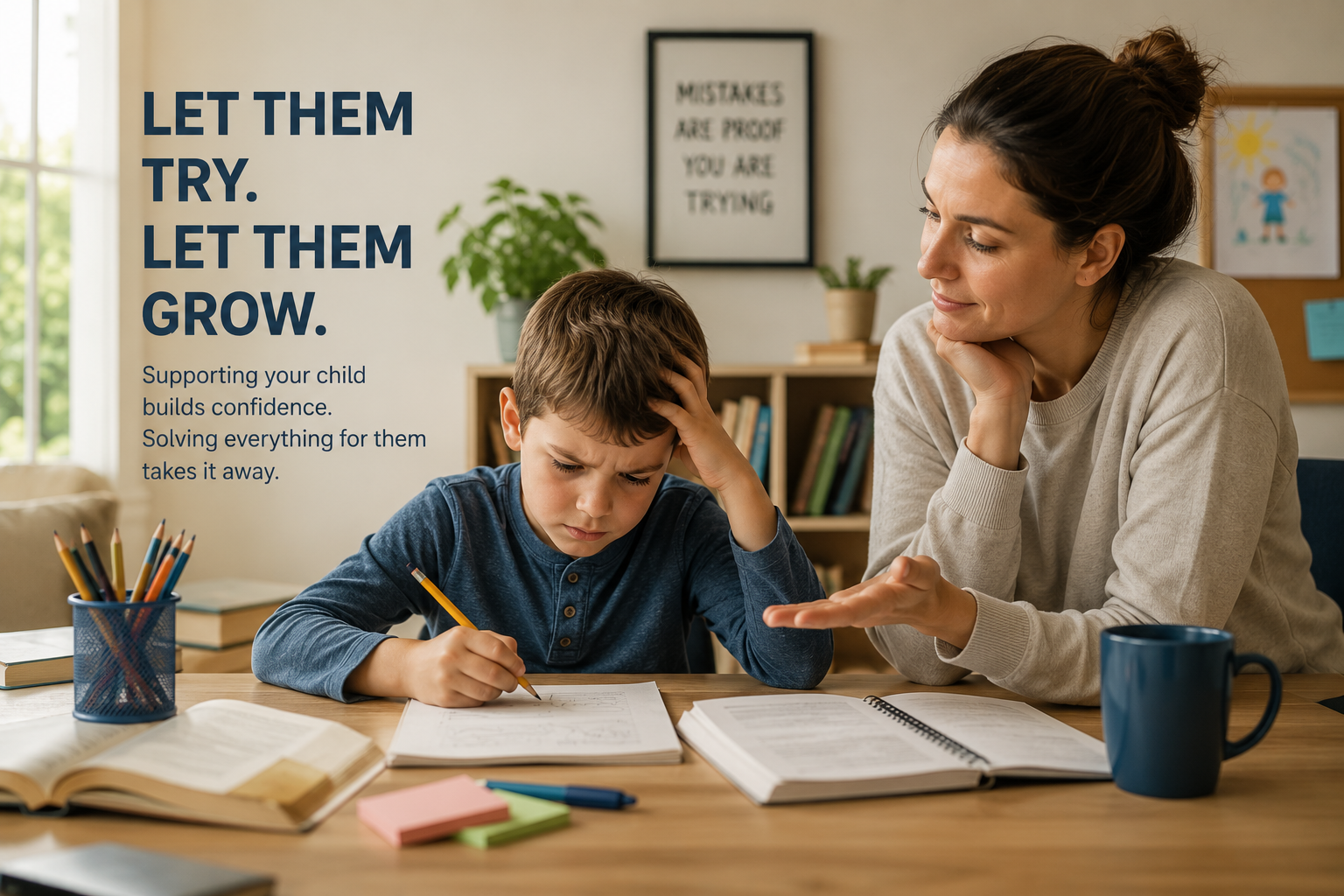
This is the most important and most consistently underestimated thing parents can do. When a child encounters something hard — a puzzle that will not solve, a project that is not going well, a social situation that requires navigation — the instinct is to step in. To help. To smooth the path.
Waiting longer than feels comfortable before intervening is, in many cases, the most powerful resilience-building act available. Not forever. Not until the child is overwhelmed to the point of shutdown. But long enough for the child to have the experience of sitting with difficulty, of trying something that does not work, of feeling frustrated and discovering that frustrated is survivable.
When you do intervene, the most useful question is almost never the answer. "What have you tried so far?" "What else could you do?" "What do you think the problem actually is?" These questions keep the work in the child's hands. They signal that you believe the child is capable of making progress. And that signal — communicated consistently over time — is one of the foundations of genuine resilience.
2. Change What You Praise
The research on this is clear and has been replicated across many different contexts: children who are consistently praised for being smart, talented or naturally gifted become less resilient than children who are consistently praised for effort, persistence and problem-solving.
The reason is straightforward. Praise for fixed qualities — being smart, being talented — ties a child's sense of themselves to outcomes they cannot fully control. When things go well, this feels wonderful. When things go badly, it feels catastrophic — because a failed attempt is now evidence that the fixed quality is not real. Children who have learned to value effort, persistence and improvement have a different relationship with failure. It becomes information rather than verdict. It tells them what to try next, not who they are.
This does not mean never acknowledging results. It means ensuring that the praise which lands most consistently is praise for the qualities that are within the child's control — and that connect directly to resilience.
3. Treat Failure as Information, Not as Outcome
How a family responds to failure shapes how a child experiences it for years. This is not about pretending failure does not matter, or about toxic positivity that dismisses genuine disappointment. It is about the frame that consistently surrounds failure in everyday family life.
A family where failure is treated primarily as evidence — of something to be avoided, of inadequacy, of something that reflects badly on parents or child — produces children who avoid failure at all costs, which means avoiding challenge. A family where failure is treated as information — what happened, what can be learned from it, what to try differently — produces children who can tolerate the experience of failing because they have evidence that it leads somewhere useful.
In practice, this looks like specific questions asked calmly after things go wrong. Not "why did you do that?" but "what do you think happened there?" Not "you should have worked harder" but "what would you do differently?" The questions are small. The cumulative effect on how a child experiences failure is not.
4. Give Children Real Responsibility With Real Consequences
Resilience does not develop in a vacuum. It develops when children have genuine ownership of things that matter — where their choices affect outcomes, where doing something badly has actual consequences, and where doing something well is genuinely theirs.
Many children today have very limited experience of real responsibility. Their lives are largely managed by adults who make most of the decisions that affect them. This is understandable — it comes from care — but it means children rarely have the experience of discovering that they can handle things. And that discovery is central to resilience.
Starting small is fine. A genuine responsibility for one household contribution per week. A creative project where the child decides the direction and accepts the results. A situation where an adult explicitly steps back and says: this one is yours. The specific content matters less than the authenticity of the ownership. Children know when they are really responsible for something and when they are just performing responsibility under adult supervision. The real thing is what builds capacity.
5. Help Children Develop Emotional Language for Difficulty
Many children give up not because they cannot tolerate difficulty but because they have no framework for what they are experiencing when difficulty arrives. The frustration, the deflation, the gap between expectation and reality — these feel overwhelming partly because they are unnamed and therefore shapeless.
Helping children name what they are experiencing in difficult moments does not fix the difficulty. But it creates a small but significant separation between the feeling and the response. A child who can say "I'm really frustrated right now" has taken one step back from the frustration — and that step is often the difference between staying in the work and walking away from it.
This happens most naturally through the conversations that follow difficult experiences, when the child is calm enough to reflect. "What were you feeling when you decided to stop?" "Was it frustration, or something else — like embarrassment maybe?" These questions, asked consistently and without judgment, build emotional vocabulary that becomes a practical tool in the moment difficulty arrives.
6. Separate Your Discomfort From Theirs
This is perhaps the most difficult thing on this list, and the one that parents most rarely hear named directly. Many of the protective interventions that reduce resilience development come not from the child's experience of difficulty but from the parent's experience of watching the child in difficulty. It is genuinely uncomfortable to watch a child you love struggle, fail or be disappointed. That discomfort is real and it is not a character flaw.
But when the intervention that removes the child's discomfort is actually driven by the parent's discomfort, it teaches the child something specific: difficulty is an emergency that requires adult rescue. That lesson — delivered not through words but through repeated experience — makes it harder for children to develop the confidence that they can handle things themselves.
Sitting with your own discomfort while your child navigates theirs is one of the most concrete acts of resilience-building available. It is also genuinely hard. But it is worth naming as what it is: not neglect, not indifference, but active support for the development of something your child will need for the rest of their life.
7. Measure Progress Against the Child's Own History, Not Other Children's
Social comparison is one of the most corrosive forces acting on a child's developing resilience. Children who constantly measure themselves against others develop a relationship with difficulty that is heavily influenced by how others appear to be handling the same difficulty — which is almost always inaccurate, because what children observe in others is the surface, not the actual experience.
Families that consistently draw attention to a child's progress relative to their own past — "that was much harder for you last month" — rather than relative to other children, give children a different frame for measuring growth. Progress becomes personal. Difficulty becomes meaningful in terms of where the child started rather than where others appear to be. This orientation, practised consistently, significantly changes how children experience their own learning curve.
Resilience and What Comes Next
The world children are growing up in will change significantly by the time they are adults. The specific skills that are most valued will shift. The careers that exist will be different from those that exist today. The challenges they will face are genuinely difficult to predict.
What is not difficult to predict is that adaptability — the ability to encounter something new, something hard, something that does not work the first time, and continue — will matter. It has always mattered. In a period of unusually rapid change, it matters more than ever.
Children who have developed resilience are not guaranteed good outcomes. But they are significantly better equipped to navigate uncertainty, to recover from setbacks, to continue learning when learning is difficult, and to engage with challenge as something generative rather than something to be avoided.
These qualities do not come from being told you are resilient. They come from having been through something hard and arrived on the other side. That experience has to be lived. It cannot be given.
You may also find these articles helpful:
emotional intelligence for kids
problem solving activities for kids
Questions Parents Often Ask
Can resilience really be developed, or is it mostly temperament?
Temperament affects the starting point — some children are naturally more emotionally reactive, some more naturally persistent. But the research on resilience development is consistent across many different populations and contexts: the environment children grow up in, and specifically the experiences of manageable difficulty they have access to, has a large and measurable effect on the resilience they develop. Temperament sets the initial conditions. Experience determines what grows from them.
My child is very sensitive — can sensitive children become resilient?
Yes, and this is important to say clearly. Sensitivity and resilience are not opposites. Sensitive children feel things more intensely — which can make difficulty harder to tolerate initially. But intensity of feeling is not the same as inability to recover. Sensitive children who are given the right support — who learn to name their emotions, who develop coping strategies that work for their particular emotional style, and who have repeated experiences of moving through difficulty — become resilient adults. The path looks different from that of a less sensitive child, but it leads to the same place.
What is the difference between supporting a child and overprotecting them?
The clearest way I can draw this distinction is this: support keeps the difficulty in the child's hands while keeping the adult present. Overprotection takes the difficulty out of the child's hands entirely. A supportive response to a struggling child says "I'm here, and I believe you can work through this." An overprotective response says "this is too hard for you right now, so I will handle it." Both come from care. Only one of them builds the capacity to handle difficulty independently.
How do I know if my child is developing resilience?
The signs tend to be quiet rather than dramatic. A child who returns to something that previously caused them to shut down. A child who, when something goes wrong, spends less time in the shutdown and more time asking what to try next. A child who describes difficulty in terms of what they are working through rather than what they cannot do. These are not the same as never struggling — they are signs that the relationship with struggle is changing in the direction that matters.
Final Thoughts
Resilience is built in ordinary moments. Not in dramatic challenges or exceptional circumstances — in the everyday friction of a life that includes things that do not work, situations that require navigation, and the gap between what a child imagined and what they actually produced.
The goal is not to expose children to unnecessary difficulty. It is to resist the instinct to remove all difficulty — and to trust that a child who is emotionally supported while struggling is gaining something that a child who is carried past every obstacle is not.
That something — the accumulated, personal, lived evidence that difficulty is survivable — is what resilience actually is. It cannot be taught in a conversation. It cannot be given through praise. It has to be built, one experience at a time, in the ordinary life of a child who is trusted to handle more than we sometimes think they can.
Start this week with one thing: the next time your child encounters something difficult, wait a little longer than feels comfortable before stepping in. See what they do with it. That moment — and the ones that follow it — is where resilience begins to grow.
If you want your child to develop resilience, problem-solving and creative confidence through structured, project-based learning designed for ages 10 to 15, you can learn more about the programme here:
entrepreneurship lessons for kids from home