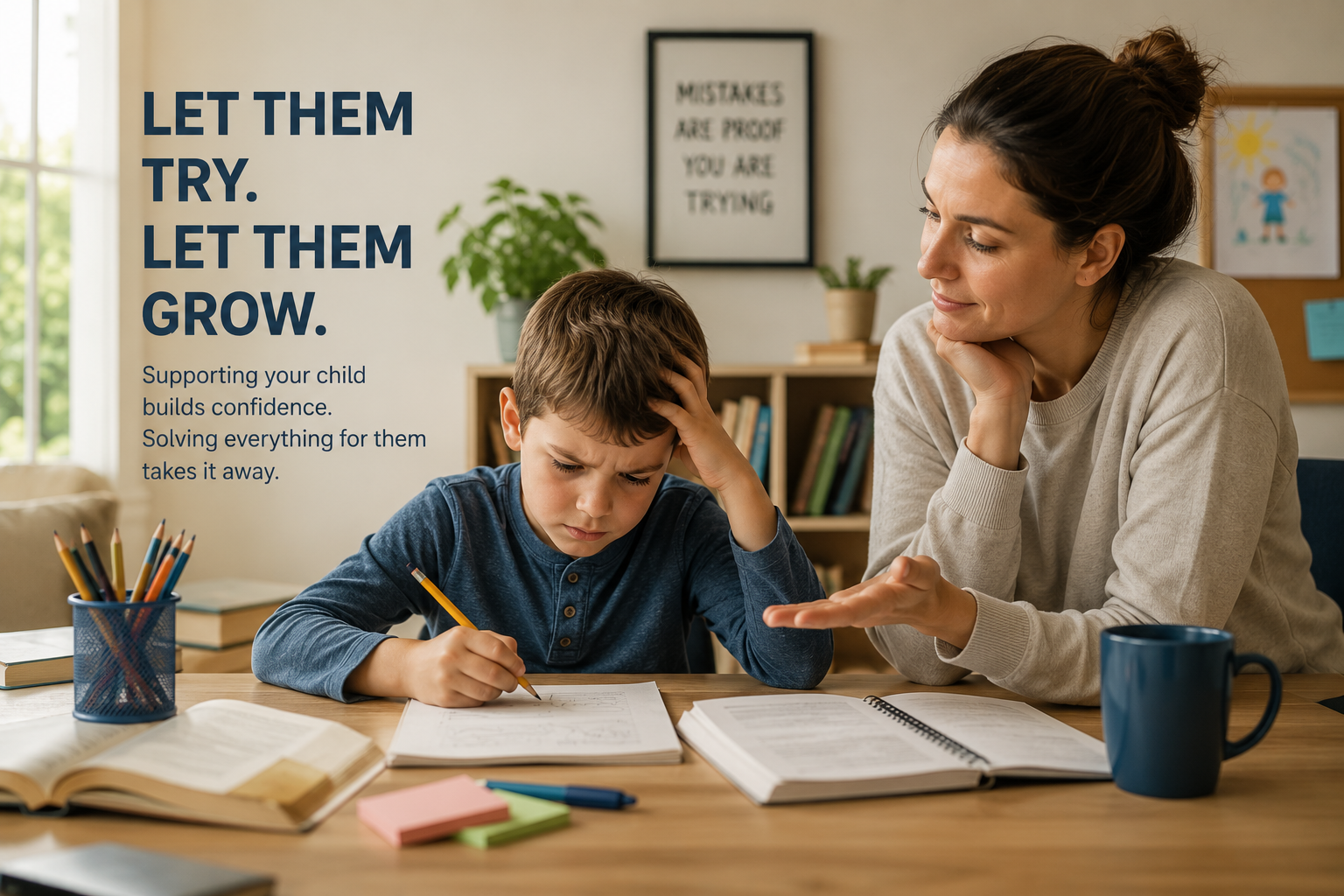

Why Parents Should Stop Solving Every Problem for Their Children
In 2019, a team of researchers at the University of Minnesota published findings from a long-term study tracking children from toddlerhood into early adulthood. One of their most striking discoveries was not about academic performance or social development. It was about a quality they called "executive function" — the ability to plan, make decisions, regulate emotions, and work through challenges independently.
Children who scored highest on measures of executive function in early childhood consistently showed better outcomes across nearly every dimension of adult life: educational achievement, employment, relationships, mental health, and the ability to navigate setbacks without becoming derailed by them.
What predicted strong executive function most reliably? Not enrichment programmes, not tutoring, not structured activities. The strongest predictor was something far simpler and far less comfortable: the experience of being allowed to struggle with age-appropriate challenges — and working through them without an adult immediately intervening.
This finding makes intuitive sense when you examine it carefully. Executive function, like any other capacity, develops through exercise. The exercise it requires is the experience of facing a genuine challenge, working out what to do, attempting something, adjusting when it does not work, and eventually arriving at a resolution. Every time an adult removes that process — however lovingly, however efficiently — the exercise does not happen. The capacity does not develop. And the child arrives at the next, harder challenge with less practice than they needed.
The research on this is not new, and it is not contested. What is contested — or at least, what most parents find genuinely difficult — is the practical implication: that one of the most important things we can do for our children is to solve fewer of their problems, not more.
The Difference Between Support and Substitution
Before going further, it is worth being precise about what we are and are not arguing for — because this conversation frequently gets misread as an argument against parental involvement, and it is not.
Children need support. They need to know that someone is watching, that they are not entirely alone with their difficulties, that if something goes genuinely wrong there is a safety net. That emotional presence is not the problem. In fact, research suggests it is one of the most important predictors of resilience — children who feel securely attached to caring adults are more willing to take on challenges, not less, because the ground beneath them feels stable.
The problem is not involvement. It is substitution — replacing the child's problem-solving with the adult's, in situations where the child was capable of working through the challenge themselves with appropriate time and support.
The practical distinction looks like this. A child is stuck on a homework problem. Support looks like: sitting nearby, asking what they have tried so far, asking what the question is actually asking, staying present while they think. Substitution looks like: explaining how to solve it, or solving it alongside them so efficiently that the child's thinking is never really required. Both feel helpful in the moment. Only one of them actually builds the capacity that the homework was designed to exercise.
A child has a conflict with a friend. Support looks like: listening carefully, helping them understand how the situation might look from the other side, asking what they think they could do. Substitution looks like: calling the other parent, speaking to the teacher, or resolving the situation in a way that removes the child's need to navigate it. Again, both feel like help. Only one teaches the child anything that will serve them the next time a social difficulty arises.
The line between the two is not always obvious, and it moves as children develop. What is appropriate support for a six-year-old is substitution for a twelve-year-old. The question worth asking, regularly and honestly, is: is this situation actually beyond my child's current capacity, or am I solving it because their struggle is uncomfortable for me to watch?
Why This Has Become Harder Than It Used to Be
Parents have always wanted to protect their children from difficulty. That is not new. What has changed is the environment in which that instinct operates — and several features of that environment make over-involvement significantly more likely than it was for previous generations.
Constant connectivity means that children and parents are rarely truly separated. A child at school who encounters a problem can text a parent immediately. A parent who hears about a difficulty can respond within minutes. The natural buffer that physical distance used to provide — the space in which children had to figure things out because there was simply no one available to ask — has largely disappeared. This is not an argument for cutting off communication. It is an observation that the architecture of modern family life has made it much easier to be involved in every difficulty, and much harder to step back.
Competitive pressure around children's outcomes has also intensified in ways that make parents feel, sometimes correctly, that the stakes of every stumble are higher than they used to be. When academic performance feels directly connected to college admission, which feels directly connected to life outcomes, a bad grade starts to feel like more than a learning opportunity. It starts to feel like a threat. The parental response to perceived threat is intervention — and the intervention that feels most immediately effective is solving the problem rather than letting the child work through it.
Finally, children's distress is genuinely difficult to sit with. This is not a parenting failure. It is neurobiology. Adults are wired to respond to children's distress, and the most immediate way to relieve that distress — for both parent and child — is to remove its source. Understanding this does not make it easier to resist. But it helps to know that the discomfort of watching a child struggle is a normal response to a situation that does not actually require rescue.
What Children Miss When Problems Are Always Solved for Them
The losses accumulate gradually and are rarely visible in any single moment. That is part of what makes this pattern so persistent — the individual interventions seem harmless, even clearly beneficial. It is only over time, looking at the whole picture, that the cumulative effect becomes apparent.
They miss the experience of discovering their own capability. There is a specific kind of confidence that develops only when a child works through something difficult and arrives at a resolution themselves. It is different from the confidence that comes from being told they are capable, or from succeeding at things that were not genuinely challenging. It is evidence-based confidence — founded on the actual experience of having faced something hard and come through it. Without enough experiences of that kind, children can develop a fragile relationship with their own capability: they feel fine when things are easy and genuinely uncertain whether they can manage when things are not.
They miss the experience of failure as information. When problems are consistently solved before they fully play out, children are also protected from the experience of things not working — and from the learning that follows. A child who tries an approach to a social conflict, finds it does not work, reflects on why, and tries differently next time has learned something genuinely valuable about how relationships work. A child whose parent resolved the conflict before it ran its course has learned that conflicts get resolved by adults. These are very different preparations for adult social life.
They miss the development of tolerance for frustration. Frustration — the feeling of being stuck, of effort not immediately producing the desired result — is one of the most important emotional experiences to develop tolerance for, because virtually every meaningful endeavour involves it. Children who are consistently rescued from frustration before it resolves develop a lower threshold for it: they become less able to tolerate the feeling, which means they are less able to stay with challenges that require persistence. This manifests in adulthood as giving up on difficult things too quickly, avoiding situations where frustration is likely, and struggling with the ordinary emotional demands of ambitious goals.
They miss the development of self-direction. Working through a problem independently requires a child to direct their own thinking — to decide what to try, to evaluate what worked and what did not, to generate new approaches when the first one fails. This process, repeated often enough, builds what researchers call self-regulatory capacity: the ability to manage your own behaviour and thinking toward a goal. Children who have had this experience taken over by adults consistently are significantly less practiced at directing their own cognitive processes — and this gap becomes particularly visible in environments where external direction is reduced, as it is in higher education and adult professional life.
The Patterns Most Worth Examining
Not all over-involvement looks the same, and it is worth being specific about the patterns that research and practice identify as most consequential.
Academic substitution. Helping a child understand a concept is support. Working through the assignment with them in a way that means the thinking is more yours than theirs is substitution. The former develops understanding; the latter develops the habit of needing assistance to produce work. The most important question is not whether the assignment is completed correctly, but whether the child can do equivalent work independently after the help.
Social intervention. Children's social difficulties are among the hardest for parents to watch and the most reflexively intervened in. A child who is excluded from a group, who has a falling out with a friend, who is treated unfairly by another child — these situations activate parental protective instincts powerfully. But social competence develops through navigating social situations, including difficult ones. Children who are consistently shielded from the friction of peer relationships do not develop the skills to manage that friction. The social environment of adulthood is substantially more complex than most of what childhood offers, and it comes without parental backup.
Emotional rescue. There is a meaningful difference between helping a child regulate a difficult emotion and removing the stimulus of that emotion before it can be processed. A child who is disappointed about something needs support in moving through that disappointment — acknowledgement, presence, and eventually help in thinking about what to do next. A child who is never allowed to experience disappointment, because parents consistently prevent the situations that would produce it, arrives at adulthood without a developed capacity for handling it. Disappointment is not only unavoidable in adult life. It is frequent.
Decision pre-emption. When adults consistently make decisions that children are capable of making themselves — what to eat, how to spend free time, how to organise their work, how to approach a challenge — children lose practice in the fundamental cognitive process of evaluating options and committing to a direction. Decision-making is a skill, and like all skills it requires practice. Adults who struggle with decisions are almost always people who had very little practice making them when they were young.
What to Do Instead
The alternative to solving problems for children is not abandoning them to struggle alone. It is a specific kind of presence that stays engaged without substituting.
The most useful shift is from answers to questions. When a child comes with a problem, the natural response is to provide a solution — partly because adults often have one, and partly because solving things feels like help. But a question does more, and does it better. "What have you tried so far?" "What do you think the problem actually is?" "What are the options?" "What would happen if you tried that?" These questions keep the thinking in the child's hands. They communicate, without saying it, that the adult believes the child is capable of working toward a solution. And that belief, communicated consistently over time, becomes the foundation of genuine self-confidence.
The second most useful shift is in the timing of intervention. Not whether to be involved, but when. Waiting longer than feels comfortable before stepping in is, in most cases, the most effective thing a parent can do. The transition from stuck to moving forward — which looks from the outside like unproductive struggle — is often exactly where the most important development is happening. Interrupting it, however gently, stops the process at the point where it was about to produce something.
The third shift is in how difficulty is framed. Adults who consistently treat children's struggles as problems to be solved are implicitly communicating that struggle is a bad sign. Adults who treat the same struggles as normal and expected — even interesting — are communicating something very different. "This is hard. What do you think you'll try?" treats difficulty as the ordinary condition of learning something real. That framing, repeated over years, changes how children relate to their own challenges.
Questions Parents Often Ask
How do I know when my child genuinely needs help versus when I should step back?
The most reliable indicator is whether the child is making any progress at all, even slowly, versus being completely stuck in a way that is producing genuine distress rather than productive frustration. A child who is struggling but still trying — even inefficiently — is usually best left to continue. A child who has been truly stuck for an extended period, who is becoming increasingly distressed rather than increasingly engaged, and who has run out of approaches to try, is a child who would benefit from some support. The key is that the support should be the minimum required to get them moving again, not a wholesale takeover of the problem.
What about situations where the stakes are genuinely high?
The higher the stakes of a situation, generally the more carefully an adult should weigh the value of letting a child work through it themselves against the real costs of a poor outcome. There is no universal answer. What is worth examining is whether "high stakes" is an accurate description of the situation, or whether it is a rationalisation for an intervention that is primarily about the parent's discomfort. Most of what children experience as high-stakes — a falling out with a friend, a difficult teacher, a disappointing grade — is not, from an adult perspective, actually catastrophic. The experience of navigating it is often more valuable than the outcome.
My child says they genuinely do not know how to approach something. Isn't it cruel to withhold help?
"I don't know how" is sometimes accurate and sometimes a shortcut to getting someone else to do the work. The distinction is usually visible: a child who genuinely does not know where to start is different from one who knows where to start but finds it effortful and would prefer not to. For the former, a minimal scaffold — pointing toward a starting point without providing the path — is appropriate support. For the latter, the most helpful response is often to stay present while they discover that they knew more than they thought they did.
Final Thoughts
The research from the University of Minnesota study, and from dozens of similar investigations conducted over the past three decades, points consistently in the same direction: the children who develop most fully — who become capable, resilient, self-directed adults — are not those whose childhoods were most carefully managed and most thoroughly protected. They are those who had enough experience of genuine challenge, appropriately supported, to develop real confidence in their own ability to handle difficulty.
That confidence cannot be given. It cannot be produced by telling a child they are capable. It can only be built, slowly and through accumulation, from the experience of actually being capable — of facing something hard, working through it, and arriving on the other side.
The most important thing parents can do is create the conditions for that experience to happen — and resist, as often as possible, the impulse to substitute their own capability for their child's.
That is harder than it sounds. It requires watching your child struggle without immediately removing the struggle. It requires tolerating uncertainty about whether they will figure it out. It requires trusting, against the evidence of the moment, that the difficulty is doing something useful.
But the alternative — raising children who have never had to figure anything out for themselves — produces adults who cannot. And that is a far harder thing to fix.
If you want your child to develop the problem-solving capacity, resilience and entrepreneurial thinking that comes from being genuinely challenged in a structured, supportive environment designed for ages 10 to 15, you can learn more about KidStartupper here:
entrepreneurship lessons for kids from home
You may also find these articles helpful:
why boredom is actually good for children