
Why Boredom Is Actually Good for Children
I want to tell you about something that happened in one of our sessions that I still think about regularly.
We had finished an activity early. There were about fifteen minutes left before parents arrived. I had nothing planned for that time — it was genuinely unstructured, unscheduled, with no task and no instruction. I told the group of twelve-year-olds: "You have some free time. Do whatever you want."
The first two or three minutes were almost painful to watch. Children looked at each other. Looked at me. Looked at the ceiling. One reached instinctively for his phone before remembering it was in his bag. Another started arranging the pens on the table into patterns. The silence was the particular awkward silence of people who have forgotten what to do when nothing is required of them.
And then something shifted.
Two students started talking quietly about something one of them had mentioned earlier in the session. A third joined in. Within five minutes, four of them were sketching something on a piece of paper — a design for something, though I could not quite see what. Another pair had pulled two chairs together and were working through a problem they had not been able to solve during the structured activity. Someone started building something with the materials left on the table, for no reason except that the materials were there and an idea had arrived.
In fifteen minutes of doing "nothing," more genuinely creative thinking happened in that room than in some of our most carefully planned sessions.
I have thought about that afternoon many times since. What I witnessed was not children wasting time. It was children remembering how to think for themselves — something that the relentless structure and stimulation of modern childhood had almost made them forget how to do.
What We Are Actually Doing When We Fill Every Moment
I understand the impulse. When a child says "I'm bored," it registers as a problem to solve. There is something uncomfortable about a child with nothing to do — it feels like a failure of provision, like we should have anticipated this and arranged something better.
So we arrange something. A screen. An activity. A scheduled class. Another organised experience designed to be engaging and educational and stimulating. And the child is no longer bored. Problem solved.
Except that it is not a problem. And filling it is not a solution.
What we are actually doing, when we eliminate boredom systematically from a child's life, is eliminating the specific conditions under which certain crucial capacities develop. Imagination. Self-direction. The ability to generate your own entertainment rather than consume someone else's. The experience of sitting with discomfort long enough for something interesting to emerge from it.
These are not minor things. They are foundational to almost everything I care about in the work I do with children. A child who has never had to figure out what to do with unstructured time has never developed the internal resources that unstructured time builds. And those internal resources — the ability to generate ideas independently, to self-direct, to tolerate the brief discomfort before something interesting arrives — are exactly what is required for genuine creative and entrepreneurial thinking.
We are, in trying to keep children perpetually entertained, quietly producing children who cannot entertain themselves. The consequences of that go well beyond childhood.
What Actually Happens in a Bored Brain
There is good neuroscience behind this, and it is worth knowing about because it reframes boredom completely.
When we are not engaged in a specific task, the brain does not simply go quiet. A network of regions called the default mode network activates — and this is the network associated with imagination, creativity, perspective-taking, and what researchers call "mental time travel": the ability to think forward and backward in time, to simulate possibilities, to connect ideas that are not obviously related.
In other words, boredom — the state of not being externally stimulated — is when the brain does some of its most sophisticated and creative work. It is the mental equivalent of the fallow period in farming: the ground that looks unproductive is actually recovering and preparing for what comes next.
When children are always stimulated — when there is always a screen, always a notification, always something demanding their attention from the outside — this network never gets to do its work. The connections do not form. The imaginative thinking does not happen. The ideas that would have emerged in the quiet space between activities never arrive, because there is never a quiet space.
I am not making a nostalgic argument about how things were better before smartphones. Things were different, not uniformly better. But something genuinely valuable is being lost in the specific trade-off modern life has made — and parents who understand what that something is are much better positioned to protect it.
What Children Do When You Let Them Be Bored
I have been watching children navigate unstructured time for two decades, and what they do when you genuinely let them be bored — when you do not immediately rescue them from the discomfort — follows a remarkably consistent pattern.
First, there is the period of adjustment. This can last anywhere from two minutes to twenty, depending on the child and how accustomed they are to having their time filled. They seem lost. They might complain. They might try to get you to suggest something. This is the moment when most adults intervene, because it looks like a problem. It is not. It is the transition.
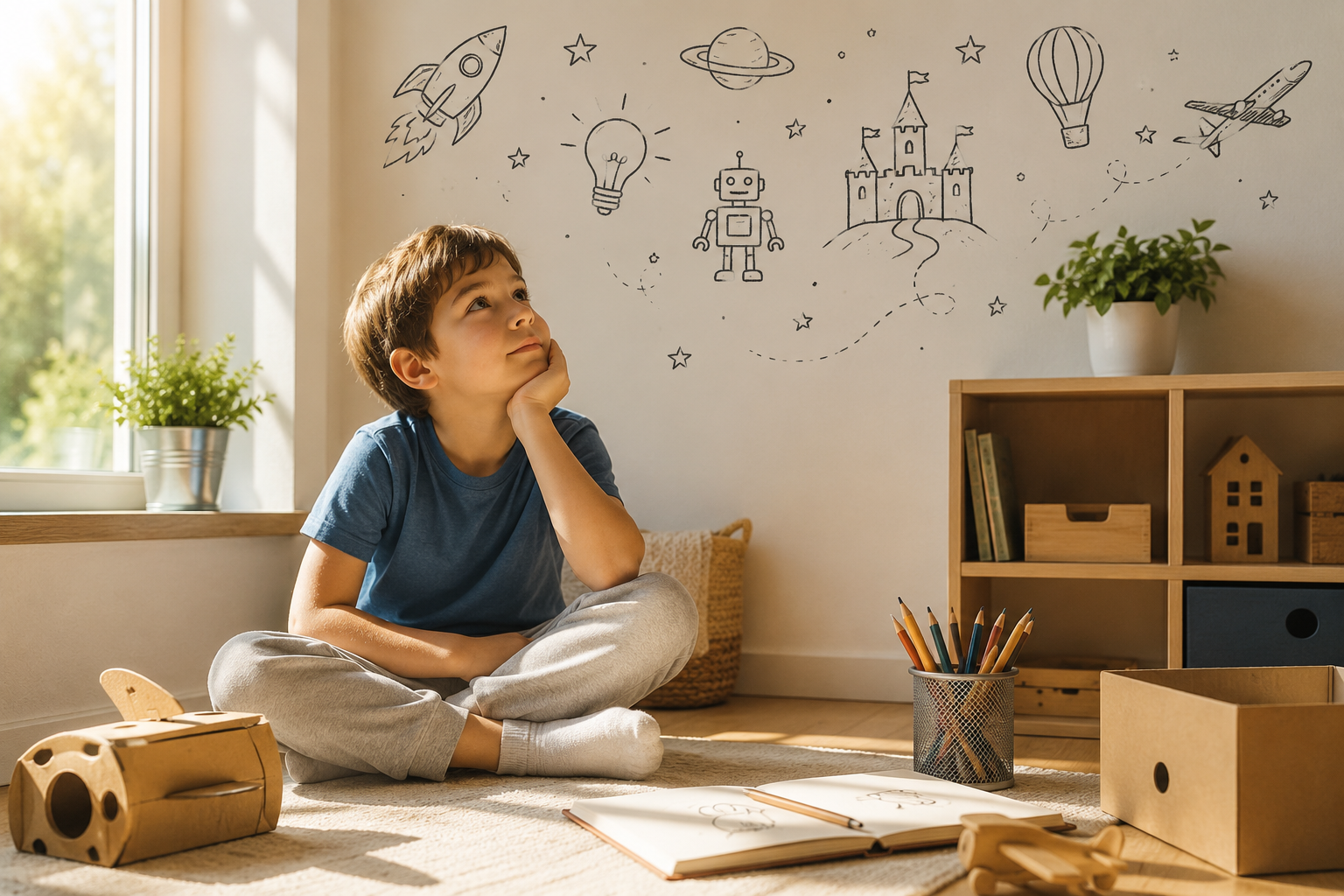
Then, something emerges. It is almost always something you would not have predicted and could not have planned. A child who decides to build something out of whatever materials are available. A conversation between two children about an idea that has been sitting unspoken. A question that arrives from nowhere and leads somewhere genuinely interesting. A project that starts small and develops its own momentum.
The ideas that arrive in this space are different from the ideas that arrive in response to a prompt or an assignment. They are more personal, more genuinely motivated, more connected to what the child actually cares about. And the child's relationship to those ideas is different too — they own them in a way that assigned ideas are never quite owned.
This is where real creative thinking begins. Not in structured activities with defined outcomes, but in the formless space where a child has to generate their own direction.
The Connection to Entrepreneurial Thinking
The reason I care so much about this in the context of what we do at KidStartupper is that entrepreneurial thinking — real entrepreneurial thinking, not the performance of it — begins exactly here.
The foundational move of any entrepreneurial mind is: I notice something, I imagine something different, I decide to try. That sequence — noticing, imagining, deciding — requires internal quiet. It requires the kind of mental space that constant external stimulation systematically eliminates.
Every meaningful business, product, or creative work that has ever existed started with someone who had enough unoccupied mental space to notice a problem and let the question of what to do about it sit with them long enough for an answer to develop. That process cannot be rushed and cannot be stimulated into existence. It requires its own kind of emptiness.
When I work with children on developing entrepreneurial thinking, one of the things I do — which always looks strange at first — is give them time that is genuinely unstructured, genuinely theirs, with no task and no outcome required. The discomfort in those first minutes is almost always followed, if I let it run, by exactly the kind of self-directed creative thinking that no structured activity produces as reliably.
I am not the most interesting thing in those moments. Their own minds are. And they discover that, often for the first time, with visible surprise.
What This Looks Like at Home
Protecting boredom does not mean doing nothing. It means making deliberate choices about what you fill time with and what you leave empty.
The most important thing is to resist the instinct to intervene the moment a child says they are bored. That statement is not a request for you to provide entertainment. It is the beginning of a transition — from external stimulation to internal generation. The transition is uncomfortable. It is also necessary. Your job in that moment is not to solve the discomfort but to let it be there long enough to do its work.
This is easier if you name it. Not "go be bored" — that sounds like a punishment. But something more like: "I know nothing is happening right now. See what comes to you." That small reframe — from boredom as absence to boredom as openness — changes how children relate to it. They start to understand that the empty feeling is not a problem. It is a space.
It also helps to reduce the immediate availability of screens during these periods. Not as punishment, but because screens are specifically designed to fill the space that boredom creates — and they fill it in a way that prevents the transition from happening. The idea is not to be without a screen forever. It is to be without one long enough for the internal process to begin.
And when something emerges — when the child comes to you with an idea, or you notice them absorbed in something they generated themselves — treat that with genuine interest and as little interference as possible. Ask what they are making, or thinking, or working out. Do not improve it or suggest how it could be different. Just be interested. That response, more than almost anything else, teaches children that what arrives in the quiet space is worth paying attention to.
Questions Parents Often Ask
How long should I let the boredom last before stepping in?
Longer than feels comfortable — which is different for every parent and every child. A useful rule of thumb: wait until you are genuinely uncertain whether you should intervene, and then wait a bit longer. The transition period before something emerges can feel quite long, especially for children who are not used to it. Twenty or thirty minutes of apparent aimlessness is not a problem. It is often the necessary preamble to something interesting. If it has been an hour and genuine distress has set in, check in. But distress and boredom are different things, and the distinction is usually visible.
My child just goes straight to screens if I do not provide something. What do I do?
This is the most common practical challenge, and it is real. Screens are specifically engineered to be more immediately rewarding than anything a child's own mind can produce in the first few minutes of unstructured time. The solution is not to eliminate screens but to create times and spaces where they are simply not the default option — periods where the rule is not "no screens as punishment" but "we have some open time and the screens will be there later." Starting with shorter periods and building up helps. So does being around but not directing — your calm, unoccupied presence signals that nothing is required, without the vacuum being filled by a device.
Is there a difference between boredom and just being lazy?
Yes, and it is worth being clear about it. Boredom is an active state — the mind searching for something to engage with and not yet having found it. Laziness is more of a settled unwillingness to make an effort. The distinction usually becomes visible fairly quickly: a bored child is restless, searching, sometimes irritable. A child who is simply avoiding effort is usually quite comfortable and not particularly interested in changing the situation. The approach for both is different, but for most children, what looks like laziness in unstructured time is actually the discomfort of the transition period — and if you wait it out, it usually resolves itself into something more active.
Final Thoughts
The fifteen minutes at the end of that session have stayed with me not because anything remarkable was produced in them — nothing was, really. A few sketches. A problem partially worked through. The beginning of an idea that might or might not go anywhere.
What stayed with me was the quality of engagement I saw in those fifteen minutes. The particular kind of attention that arrives when something is genuinely self-generated rather than assigned. The way children who had been somewhat passive during the structured activity came alive in the unstructured time — not because the structured activity was bad, but because the unstructured time was offering something different. Something their own.
That quality of engagement — genuinely self-directed, genuinely curious, genuinely creative — is what I am trying to develop in every child who comes through our programme. And I have learned, over many years, that it cannot be produced by structure alone. It needs space. It needs quiet. It needs, sometimes, a period of genuine uncertainty about what to do next.
It needs, in other words, the thing we spend so much energy eliminating from children's lives.
If you want your child to develop the self-direction, creative confidence and entrepreneurial thinking that genuine unstructured time helps build — alongside structured, project-based learning designed to channel those capacities productively — I would love for you to try KidStartupper. Seven days free. No commitment. And what you see in that time will tell you everything you need to know.
start your child's free trial here
You may also find these articles helpful:
the problem with rewarding kids only for results
why smart kids often struggle in the real world
why kids should learn how to make decisions