
Why Kids Should Learn How to Make Decisions
There is a moment that happens in almost every group project we run at KidStartupper, and it tells us more about a child than any grade ever could.
The team has been working together for a while. They have ideas. They have energy. They are genuinely engaged. And then they reach a fork in the road — two possible directions, both with merit, both with risk. Someone has to decide which way to go.
What happens next divides children into two very distinct groups.
Some children lean in. They look at the options, they ask a question or two, and they say: "I think we should go this way, because..." They make a call. Sometimes it is the right one. Sometimes it is not. But they make it, and the group moves forward.
Others freeze. Not because they are not smart enough to see the options. Often the children who freeze have thought about the situation more carefully than anyone. They freeze because they are waiting — for someone to tell them the right answer, for the uncertainty to resolve itself, for an adult to step in and take responsibility off their hands.
We have worked with hundreds of children across many different backgrounds and ability levels, and we have noticed one thing consistently: the children who handle uncertainty well — who can make a decision with incomplete information and keep moving — are not necessarily the most academically gifted. They are the ones who have had the most practice making real decisions. And in most children's lives, that practice is rarer than it should be.
The Skill Nobody Is Teaching
Decision-making is one of those skills that everyone assumes children will somehow develop on their own, without deliberate instruction or practice. The assumption is that by the time they are adults, they will simply know how to make good choices.
What we see tells a very different story.
Most children's lives are, understandably, heavily managed by adults. Parents decide what children eat, what they wear, which activities they join, how they spend their evenings, how problems in their lives get resolved. Schools decide what children learn, when they learn it, how long they spend on each subject, and what the correct answer looks like. The structure is well-intentioned and often necessary. But it has a side effect that does not get discussed enough: children graduate from eighteen years of carefully managed existence with very little practice in the one skill that adult life demands constantly.
Decision-making is not a talent. Some children may have temperamental qualities — confidence, comfort with uncertainty, a natural bias toward action — that make it easier. But the core capability is a skill, and like every skill, it develops through practice. Through making actual choices, experiencing actual consequences, reflecting on what happened, and making better choices next time.
The question worth asking is: how much of that practice are children in our care actually getting?
What Decisions Actually Teach
When a child makes a real decision — not a simulated one, not a hypothetical, but an actual choice with actual consequences — something specific happens in their development that no amount of instruction can replicate.
They experience the direct connection between their choices and their outcomes. This sounds obvious, but it is profoundly formative when experienced rather than explained. A child who decides to put off a project until the last minute and then lives through the stress and quality reduction that results has learned something about planning that ten conversations about time management could never reach. A child who chooses how to spend a small budget, runs out of money before the end of the period, and has to manage that situation has learned something about financial decision-making that a lesson on the topic could not produce.
Consequences are the best teachers available — provided they are safe, appropriate to the child's age, and genuinely allowed to play out rather than being rescued away by an adult who cannot stand to watch their child be uncomfortable.
In our sessions, we design activities specifically to create this kind of experience. Teams are given real constraints, real options, and real accountability for the choices they make. We observe what happens. And what we consistently see is that children who go through this process — who make choices, experience outcomes, debrief on what worked and what did not, and try again — change in ways that are visible and lasting. They become more comfortable with uncertainty. They start trusting their own judgment. They stop waiting to be told what to do.
The Confidence That Actually Lasts
Parents talk to us often about wanting their children to be more confident. It is one of the most common things we hear. And it is worth being precise about what kind of confidence actually serves children in the long run — because there are two very different kinds, and only one of them holds up when things get hard.
The first kind is confidence based on other people's approval. It feels real, but it is fragile. A child whose confidence comes primarily from being told they are smart, talented, or exceptional feels fine when things are going well — and feels genuinely threatened when something challenges that image. We see this regularly in children who have excelled academically: they have been told so many times how capable they are that encountering a genuine challenge starts to feel like evidence that it was all a mistake.
The second kind of confidence is based on evidence. Personal, accumulated, experiential evidence that you can handle difficult situations. It develops specifically through making decisions in conditions of real uncertainty, sometimes getting it wrong, recovering, and getting it right the next time. This kind of confidence does not depend on the situation being easy or familiar. It holds up precisely because it has already been tested.
One of the things we find most rewarding in our work is watching this second kind of confidence develop in real time. A child who in the first session deferred every decision to their group and would not commit to a position for fear of being wrong — the same child, several weeks later, presenting a decision to the full group and explaining their reasoning clearly and without apology. That shift does not come from being told they are capable. It comes from having been in situations where they had to be, and discovering that they were.
Decision-Making and Critical Thinking Are the Same Skill
There is a connection between decision-making and critical thinking that does not always get enough attention.
Every real decision requires the same cognitive moves: gathering relevant information, identifying what actually matters and what does not, considering different options and their likely consequences, weighing what you gain and what you risk with each choice, and committing to a direction even when certainty is not available. These are exactly the moves that define critical thinking.
This matters particularly now. Children today are growing up in an information environment that is genuinely unlike anything previous generations navigated. The volume of content available to them — through social media, AI tools, online communities, streaming platforms — is enormous. And a significant portion of it is designed specifically to influence their beliefs, their choices, and their behaviour, often without making that agenda visible.
Children who have developed strong decision-making skills have a meaningful defence against this. They are practised at asking: what is the evidence for this? What are the alternatives? Who benefits from me believing this? What would change my mind? These questions do not feel academic to them — they feel like the natural way to approach any situation. That orientation, developed through years of making real choices and thinking seriously about them, is one of the most valuable things a child can carry into the media environment they are already living in.
Why We Focus on This at KidStartupper
Our programme is built around entrepreneurial thinking, and entrepreneurship is fundamentally a decision-making practice. Every element of building something new — identifying a problem worth solving, choosing which approach to take, deciding how to communicate an idea, evaluating whether something is working and what to change — requires making choices under uncertainty with real consequences.
This is not incidental to what we do. It is the point.
When a team of 11-year-olds in our programme has to decide how to position their idea for a specific audience, they are not just doing a business exercise. They are practising the cognitive and emotional skills that will determine how they approach every significant challenge in their adult lives. When they make a choice that does not work out and have to figure out what to do next, they are developing the resilience and judgment that no academic programme can build directly.
The entrepreneurial context creates what most school environments cannot: genuine stakes, genuine uncertainty, genuine ownership of outcomes, and genuine practice in making decisions that matter. The specific content — the product ideas, the pitch presentations, the team challenges — is less important than the experience of being genuinely responsible for something and having to think clearly about it.
We have seen children who came to us unable to express an opinion without looking to see if an adult approved first leave with the ability to make a case for a position, handle pushback, and hold their ground when the argument is sound. That transformation does not happen because we taught them decision-making theory. It happens because we put them in situations where they had to decide things, created space for them to experience the consequences, and helped them reflect on what they learned.
What Parents Can Do Right Now
The good news is that building decision-making capability does not require a programme or a curriculum. A significant portion of it can happen in everyday family life, through small, deliberate changes in how adults relate to children's choices.
The most powerful shift is also the simplest: before providing an answer or a solution, ask a question. "What do you think?" "What are your options?" "What would happen if you tried that?" "What would you do differently if you were in charge?" These questions are not rhetorical. They are genuine invitations to think, and children respond to them very differently than they respond to being told what to do.
Give children real decisions over things that genuinely affect them. Not symbolic decisions where the adult has already decided and is just performing inclusion — real ones, where the child's choice actually determines what happens. What the family does on a free afternoon. How a shared space in the home is organised. How a family challenge is approached. These opportunities exist constantly. The question is whether adults step into them or step back.
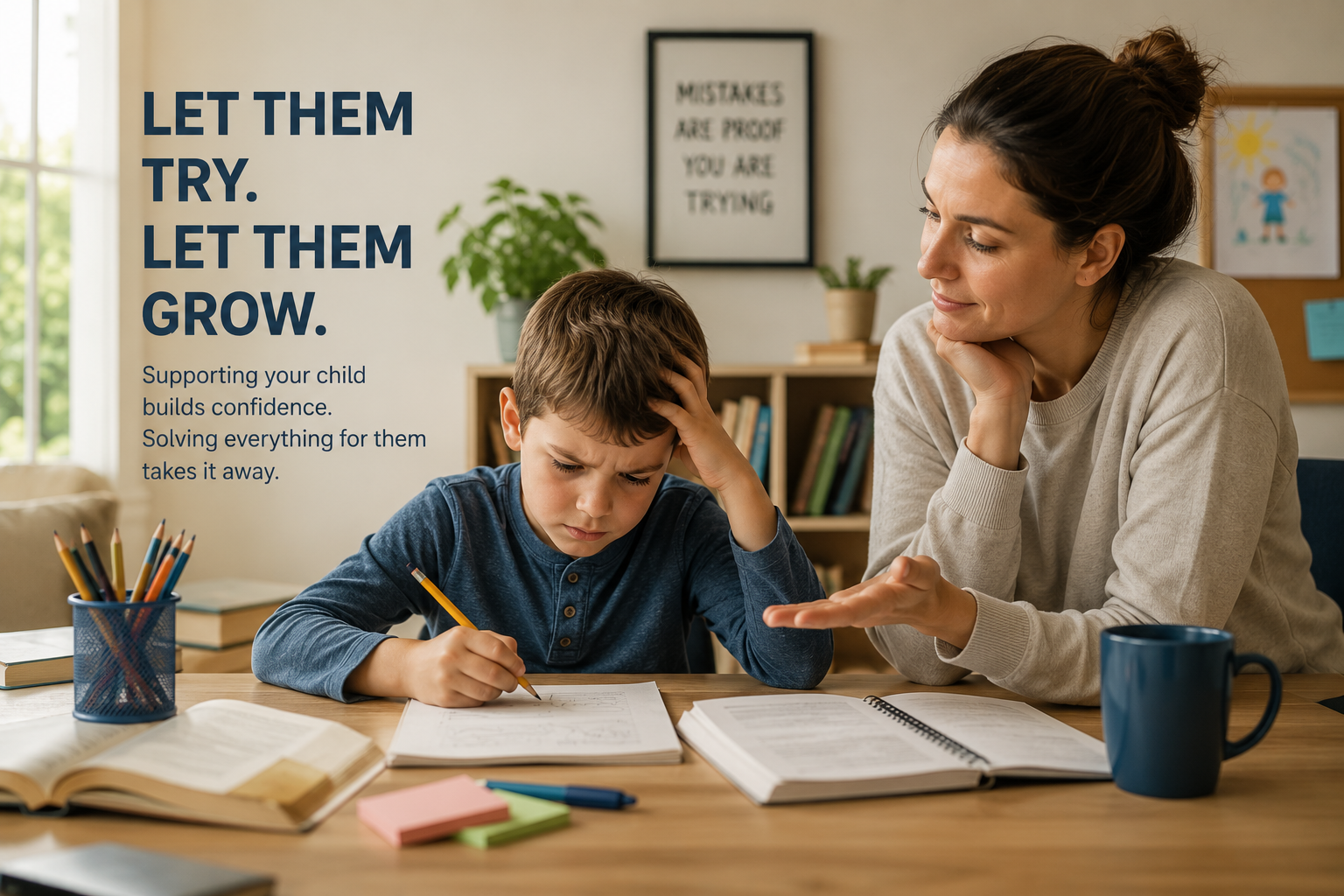
Allow natural consequences to play out when they are safe and appropriate. This is the hardest thing for most caring parents to do, because it requires watching a child experience something uncomfortable without fixing it. But the discomfort of a manageable consequence — experienced, processed, and learned from — is worth significantly more than the protection of having it removed. A child who learns to navigate the results of their own choices develops something that no amount of guidance can substitute for.
And talk about decisions after they happen. Not to evaluate whether the child was right or wrong, but to understand together what they were thinking, what they noticed about the outcome, and what they might do differently. This reflection practice — simple, regular, low-pressure — is where a large amount of the actual learning from decision-making experience is consolidated.
Questions Parents Often Ask
How do we know when a child is ready to make more decisions?
The honest answer is that children are almost always more ready than adults assume. The instinct to protect children from difficulty is natural and comes from genuine care — but it consistently underestimates what children can handle when they are appropriately supported. A useful rule of thumb: if the consequence of a bad decision is safe and manageable, the child is probably ready to make it. The experience of navigating the consequence is part of the preparation for the next, harder decision.
What if my child consistently makes choices we think are wrong?
First, separate "wrong" from "different from what we would choose." Many choices that look wrong to adults are simply different — reflecting the child's priorities, values, and way of seeing things rather than poor judgment. For choices that are genuinely problematic, the approach that develops judgment most effectively is conversation rather than override: understanding why the child made the choice they did, exploring together what might have been missed, and involving them in thinking through better alternatives. Overriding choices consistently produces dependence. Talking through them produces better thinking.
Does this apply to shy or less confident children?
Especially to them. In our experience, shy children often have excellent judgment and strong ideas — what they lack is the experience of trusting and expressing that judgment in situations where it might be questioned. The decision-making practice we are describing is precisely what builds that trust. It needs to happen in environments that feel safe and start with lower stakes, but the developmental value for quieter children is, if anything, even greater than for those who are naturally outspoken.
Final Thoughts
The children in our programme today will be adults in less than a decade. The world they are entering will ask them, constantly and without preparation time, to make decisions with incomplete information, real consequences, and no guarantee of getting it right.
The children who will navigate that world most effectively are not necessarily the ones who know the most. They are the ones who have the most practice making real choices and dealing honestly with what follows.
That practice starts earlier than most people think. It happens in small moments that do not look significant at the time. It develops through accumulated experience rather than any single lesson. And it is one of the most valuable things any parent or educator can deliberately cultivate.
If you want your child to develop the decision-making confidence, entrepreneurial thinking and real-world problem-solving skills that our programme is built around — in a structured, project-based environment designed specifically for ages 10 to 15 — we would love for you to try it. We offer a free seven-day trial, and what you see in that first week usually tells you everything you need to know.
start your child's free trial here
You may also find these articles helpful:
why smart kids often struggle in the real world