
What Should Parents Look for in an Online Entrepreneurship Program for Kids?
Every week, I hear from parents who have already paid for one children's learning programme that did not deliver what they expected. A polished website. An impressive list of features. Confident promises about future skills and creative thinking. And then their child watches a few videos, loses interest, and the subscription quietly renews for another month before anyone notices.
I am not saying this to alarm you. I am saying it because I want you to make a genuinely informed decision — whether that decision results in your child joining KidStartupper or not.
After twenty years in education and more than a decade building an entrepreneurship programme for children, I have a clear picture of what separates learning experiences that actually change how a child thinks from those that simply make parents feel like they are doing something. The difference is not about production value or price. It is about a small number of specific things that most parents do not know to look for.
Here is exactly what I would look for — and what I would walk away from — if I were choosing a programme for my own child.
The Single Most Important Question to Ask
Before anything else — before curriculum, before price, before features — ask this:
Is my child doing the thinking, or watching someone else do it?
This question eliminates the majority of children's online programmes immediately.
A child can watch fifty hours of content about entrepreneurship and emerge from it having learned almost nothing that will change how they approach challenges, decisions, or creative problems. Watching is not learning. Consuming is not developing. And a child who has been presented with information — however well-presented — has not built the capacity to use it.
The programmes that produce visible, lasting change in children are those where the child's own thinking determines the outcome of every activity. Where the answer is not already known. Where the child has to generate their own direction, make their own decisions, and experience the direct consequences of their own choices.
That kind of learning is uncomfortable in a productive way. It requires the child to actually try. And it produces something that passive content consumption never will: genuine capability.
Everything else on this list matters. But if you only ask one question, ask that one.
Look at What the Child Actually Produces — Not What the Programme Promises
Every programme promises creativity, future skills, and entrepreneurial thinking. These words have been so thoroughly appropriated by educational marketing that they have nearly lost meaning.
Cut through them by asking a concrete question: at the end of this programme, what will my child have built?
Not "what concepts will they have been exposed to?" Not "what vocabulary will they have learned?" What will they have actually made, designed, developed, or created — and who will have seen it?
The best entrepreneurship programmes for children produce tangible work: an idea developed from initial observation through to a presented solution, a product concept built through genuine research and iteration, a pitch delivered to a real audience with real responses that the child had to handle in real time.
The experience of creating something and standing behind it — of explaining it to people who were not already disposed to agree, of handling questions and pushback, of adjusting based on feedback — is one of the most developmentally significant things a child can do. It builds the kind of communication confidence, resilience, and self-belief that no amount of watching or reading can produce.
If a programme cannot clearly answer "here is what your child will create and who will see it," that is a significant warning sign.
The Curriculum Must Have a Spine
A collection of interesting lessons is not a curriculum. A curriculum is a structured progression where each stage builds on what came before — where the child is not simply accumulating information but developing a growing capacity to use it.
In entrepreneurship education for children, a well-designed curriculum moves through a logical sequence. Children learn to observe and identify real problems before they are asked to generate solutions. They learn to evaluate ideas honestly before they are asked to defend them. They develop communication skills in low-stakes situations before they are expected to perform in high-stakes ones. They experience small creative cycles — notice, imagine, build, test, improve — before they are asked to execute longer and more complex projects.
This sequencing matters enormously. A child who is asked to pitch a business idea before they have learned to identify a genuine problem will produce superficial work that teaches them little. A child who has developed real problem-finding ability first will produce work that genuinely challenges and develops them.
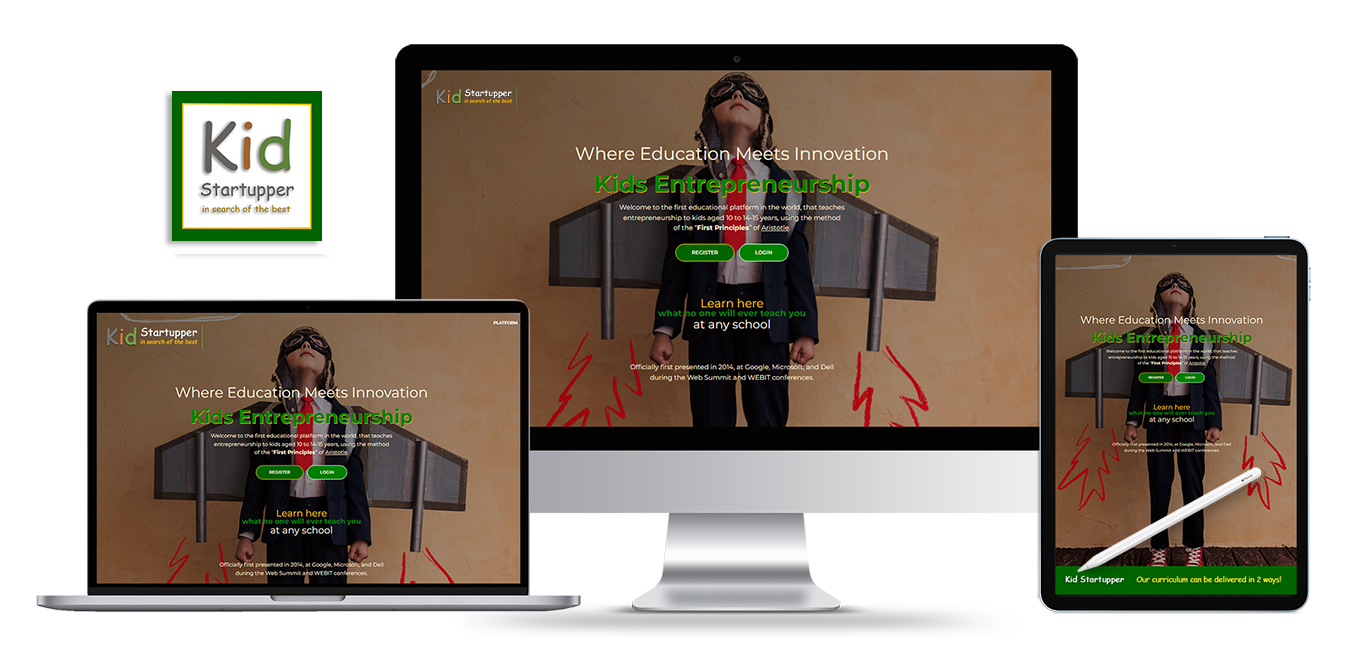
At KidStartupper, our three-year home programme is built around this progression — with each year developing the capacities that the next year requires. Children do not simply move from lesson to lesson. They move from one stage of development to the next, with each stage changing what they are capable of.
The Programme Must Have Been Built for Children, Not Adapted from Adult Content
This is easier to spot than you might think.
Adult entrepreneurship content adapted for children tends to use slightly simplified vocabulary while maintaining the conceptual framework of business education designed for people who are about to start companies. It talks about customers, revenue, marketing, and competitive advantage in ways that are technically accurate and genuinely irrelevant to the developmental needs of a ten-year-old.
Content built specifically for children aged 10 to 15 looks completely different. It meets children where they are cognitively and emotionally. It uses examples drawn from the actual texture of their lives — school, friendships, the things they notice and care about. It introduces concepts like value, cost, and communication not as business vocabulary but as ideas that illuminate how the world already works around them. And it develops those ideas through activities that are genuinely engaging for children at this developmental stage — not because they are "gamified," but because they are genuinely appropriate.
The simplest test: show your child a sample lesson. Not to see if they find the topic interesting — to see if the content feels like it was made for them, or made for someone else and handed down.
Independent Thinking Must Be Built Into Every Activity
One of the clearest markers of a genuinely valuable entrepreneurship programme is how often children are asked "what do you think?" rather than "what is the answer?"
Entrepreneurship — real entrepreneurship, not the simulation of it — involves genuinely uncertain situations where multiple approaches might work and where the quality of your thinking determines the outcome. A programme that consistently guides children toward predetermined correct answers is not developing entrepreneurial thinking. It is developing the habit of finding the right answer, which is something schools already do extensively.
The programmes that develop genuine entrepreneurial capability put children in situations where they have to generate their own direction. What problem do you notice? What would you try? Who do you think needs this? What would you change if the first approach did not work? What would you do next?
These questions do not have single correct answers. They have better and worse answers — and the process of working toward better answers is exactly where the development happens.
At KidStartupper, we build this into every stage of the learning experience. Our framework draws on Aristotle's First Principles method — reasoning from the ground up rather than by analogy to what already exists — specifically because it trains children to generate original thinking rather than reproduce received ideas. That capacity, developed consistently between ages 10 and 15, becomes one of the most durable and valuable things a child carries into adult life.
What the AI Era Actually Demands from Children's Education
I want to be direct about something that most educational marketing gestures toward without actually confronting.
Artificial intelligence is in the process of automating the cognitive tasks that traditional education has always prioritised. Information retrieval. Accurate reproduction of knowledge. Completion of defined tasks with known correct outcomes. These are precisely what AI does faster, more accurately, and more cheaply than any human.
The children currently aged 10 to 15 will enter a labour market where these capabilities are dramatically commoditised. What will be valued — what will be genuinely scarce and therefore genuinely rewarded — is the ability to do what AI cannot reliably do: identify which problems are worth solving, generate genuinely original approaches, communicate in ways that build human trust, take responsibility for outcomes, and create things that did not exist before.
These are not abstract future skills. They are the specific capacities that good entrepreneurship education develops. And the window for developing them most effectively — the 10 to 15 age range — is not theoretical. It is grounded in decades of research on cognitive development and the formation of durable thinking habits.
A child who goes through KidStartupper between ages 10 and 15 will not just be more prepared for entrepreneurship. They will be more prepared for a future in which the work most worth doing is the work that only humans can do well. That is not a marketing claim. It is the most accurate prediction I can make about the coming two decades — and it is why I believe this window matters as much as I do.
The Non-Negotiables: Safety, Privacy, and Transparency
These deserve direct attention, not a bullet-point list.
When a child uses an online educational platform, their safety and privacy are not secondary considerations. They are prerequisites. Before any conversation about curriculum or pedagogy, parents should know: what data does this platform collect? How are children's accounts protected? Who can communicate with students? What parental oversight exists? What happens to user data if circumstances change?
At KidStartupper, we take these questions seriously — not because we are required to, but because the parents who trust us with their children's learning deserve to know exactly what they are agreeing to. If any platform cannot answer these questions clearly and specifically, that alone is reason to look elsewhere.
The Questions to Ask Before Choosing Any Programme
To make this as practically useful as possible: here is exactly what I would ask, and what the answers should look like.
"What will my child create?" The answer should be specific. Not "they will develop entrepreneurial thinking" — what tangible work will they produce, and who will see it?
"Was this built specifically for children, or adapted from adult content?" Ask to see a sample lesson. The answer will be obvious within minutes.
"How much of the programme is the child actively doing versus passively consuming?" A good programme should not be able to complete itself without the child's input. If a child can progress simply by watching videos, the programme is not developing the right things.
"How does difficulty increase over time?" A curriculum that does not become progressively more challenging is not a curriculum. It is a content library.
"What happens when a child gets stuck?" The answer reveals how the programme handles the moments that matter most — not the easy lessons, but the ones where a child is genuinely uncertain and needs to figure something out.
"Is there a trial?" Any programme confident in its value should let you experience it before committing. We offer seven days completely free — no credit card, no commitment — specifically because we know what the first week produces and we want parents to see it for themselves.
Why Parents Who Try KidStartupper Usually Stay
I will be honest about this, because I think honesty is more persuasive than claims.
Parents who try our programme and do not continue fall into two categories. Some discover that the level of challenge is more than their child wanted — that our programme genuinely asks more of children than they were expecting, and the child is not ready to meet that challenge yet. I respect that. We are not the right fit for every family at every moment.
The majority of parents who try the programme and then decide to continue say some version of the same thing: "I saw my child do something I had not seen them do before." Not perform. Not complete. Actually think through something difficult, generate their own direction, and arrive at something genuinely theirs.
That experience is what we are built to produce. It is available in the first seven days. And it will tell you more about whether KidStartupper is right for your child than anything else I could write here.
Final Thoughts
The decision to invest in your child's learning outside of school is not a small one. It requires time, money, and the confidence that what you are choosing will actually produce something lasting.
The way to make that decision well is not to find the programme with the most impressive marketing. It is to understand clearly what you are looking for — a child who is genuinely developing, in the specific ways that the coming decades will reward — and to evaluate every programme against that standard with honest, specific questions.
I believe KidStartupper holds up against that evaluation. Not because of what we say about ourselves, but because of what parents see in their children during the first week of the free trial.
That is the only argument I need to make. And the only one worth making.
Seven days. Free. No commitment. No credit card required.
See what your child does with it.
start your child's free 7-day trial here
You may also find these articles helpful:
is an entrepreneurship course worth it for a 10-year-old?
most schools still train employees, not entrepreneurs
the kids who will thrive in the AI era