
What Does a Child Actually Learn in an Entrepreneurship Program? (A Research-Backed Answer)
The question sounds simple. The answer is more interesting than most parents expect.
When families research entrepreneurship education for children, they typically encounter one of two types of content: marketing material that promises creativity and future skills without much specificity, or academic research that is too technical to be practically useful. Neither gives parents what they actually need — a clear, evidence-grounded picture of what genuine entrepreneurial learning produces in children aged 10 to 15.
This article is our attempt to provide that picture. It draws on research in developmental psychology, educational science, and our own observations from working with children across multiple countries and educational contexts. Our goal is not to persuade you that entrepreneurship education is valuable. It is to give you a precise understanding of what it develops — so you can evaluate any programme, including ours, against a clear and honest standard.
The Foundational Distinction: Entrepreneurship Education vs. Business Education
The most common misconception about children's entrepreneurship programmes is that they are simplified versions of adult business education. This misunderstanding leads parents either to overestimate what is appropriate for children (expecting them to write business plans and learn financial modelling) or to underestimate what good entrepreneurship education actually offers.
Business education for adults focuses primarily on managing existing systems: finance, operations, marketing, strategy. It assumes prior experience and asks: how do you run something that already exists?
Entrepreneurship education for children focuses on something more fundamental: developing the cognitive and behavioural dispositions that enable a person to create value from nothing. It does not assume prior experience. It asks: how do you see a problem, imagine a solution, and do something about it?
This distinction matters because the skills these two approaches develop are genuinely different. And for children aged 10 to 15, the entrepreneurial approach develops capacities that are both more developmentally appropriate and more durably valuable than any amount of business vocabulary.
What the Research Shows Children Actually Develop
The following is drawn from peer-reviewed research on entrepreneurship education outcomes for children and adolescents, combined with our own programme data.
1. Problem Identification and Opportunity Recognition
The cognitive habit of noticing what does not work — and asking whether it could be better — is one of the most fundamental capacities that entrepreneurial education develops. Research by Krueger (2000) and subsequent work in entrepreneurial cognition identifies "opportunity recognition" as a trainable skill, not an innate talent. Children who receive structured practice in observing environments, identifying pain points, and formulating problem statements develop significantly stronger opportunity recognition ability than those who do not.
In practical terms: children in good entrepreneurship programmes stop seeing problems as simply annoying and start seeing them as potentially interesting. That shift in orientation — from consumer to observer to potential creator — is one of the most consistent outcomes we measure in our own work.
2. Ideation and Creative Problem-Solving
Creativity in entrepreneurial contexts is not primarily about artistic expression. It is about the capacity to generate multiple possible approaches to an undefined problem, evaluate those approaches against real-world constraints, and select or synthesise a workable direction.
Research published in the Journal of Creative Behavior consistently shows that structured ideation practice — brainstorming with constraints, generating alternatives deliberately, challenging first-answer thinking — produces measurable improvements in creative problem-solving capacity in children. These improvements transfer across domains: children who develop stronger ideation skills in entrepreneurship contexts show improved creative thinking in academic and social contexts as well.
The specific mechanism is important: entrepreneurship education develops creativity not by removing constraints but by training children to work productively within them. That is a more sophisticated and more durable form of creative development than open-ended creative play alone produces.
3. Decision-Making Under Uncertainty
Most educational environments present children with well-defined problems and known correct answers. Entrepreneurship is structured around the opposite: poorly defined problems, multiple possible approaches, and genuine uncertainty about outcomes.
Research on executive function development in adolescents (Casey et al., 2008; Steinberg, 2010) shows that this age window — roughly 10 to 15 — is a critical period for developing the prefrontal capacities associated with decision-making, impulse regulation, and planning under uncertainty. Children who receive structured practice in making consequential decisions during this window develop stronger executive function than those who do not.
Practically, this means children learn that: not every decision has a correct answer; decisions have real consequences that you have to manage; and the process of deciding — gathering information, weighing options, committing to a direction — is itself a learnable skill.
4. Communication and Persuasion
The ability to explain an idea in a way that makes another person understand and care about it is one of the most economically valuable communication skills a person can possess. It is also one of the least systematically taught in traditional education.
Research on communication development in children consistently shows that authentic audience experiences — situations where the child is genuinely trying to persuade someone who has not already committed to listening receptively — produce significantly stronger communication development than classroom presentations graded by teachers. The difference is the stakes: when the outcome is not predetermined, children engage differently.
In entrepreneurship programmes, children regularly present ideas to audiences whose responses are genuine, argue for positions that others may challenge, and adjust their communication in response to real-time feedback. These experiences develop communication capacities that academic writing and classroom presentations do not reach.
5. Financial and Economic Literacy
Financial literacy education for children is most effective when it is embedded in genuine decision-making contexts rather than delivered as abstract content. Research from the Consumer Financial Protection Bureau and academic work in financial education consistently demonstrates that children who learn financial concepts in the context of real decisions — what does this cost? why would someone pay for this? what happens if you spend more than you earn? — retain and apply those concepts significantly more effectively than those who learn the same content in isolation.
Entrepreneurship programmes naturally create these contexts. Children who work through the economics of bringing an idea to market are not learning finance as a subject. They are developing financial intuition through experience — and that intuition proves far more durable.
6. Collaboration and Team Dynamics
Collaborative learning research (Johnson and Johnson, 2009) consistently distinguishes between cooperative learning — where students divide tasks and complete their parts independently — and genuine collaborative learning, where interdependence is structured such that the group cannot succeed without each member's genuine contribution.
Good entrepreneurship programmes create the second type. When a team is developing and presenting a real idea, each member's thinking genuinely affects the outcome. Disagreements must be navigated because they have real consequences. Contributions must be made because their absence is visible. This experience develops the specific social and cognitive skills that genuine collaboration requires — listening, negotiating, integrating different perspectives, maintaining shared direction — in ways that assigned group work typically does not.
7. Resilience and Response to Failure
Research by Dweck (2006) and subsequent work on growth mindset has demonstrated that children's response to failure — whether they treat it as information or as verdict — is one of the strongest predictors of long-term achievement. This orientation is shaped significantly by the learning environments children are placed in during development.
Entrepreneurship programmes create natural, safe-to-fail contexts: situations where an idea does not work, a presentation does not land, an approach needs to be revised. When these situations are handled with the right pedagogical framing — not "you failed" but "what does this tell you?" — they produce measurable increases in growth mindset orientation and resilience over time.
This is one of the most consistent findings in our own programme data: children who complete a full learning cycle in KidStartupper show significantly increased willingness to attempt difficult things, increased persistence when things do not work immediately, and decreased avoidance of situations where failure is possible.
8. Initiative and Self-Direction
The disposition to begin something without being told to — to see a gap and move to fill it rather than waiting for instruction — is one of the capacities most consistently identified by employers as both highly valuable and increasingly rare.
Research on self-determination theory (Deci and Ryan, 2000) shows that autonomy-supportive learning environments — those that give learners genuine ownership of decisions and genuine responsibility for outcomes — produce significantly higher levels of intrinsic motivation and self-directed behaviour than controlled environments. Entrepreneurship education, by its nature, requires children to make genuine choices about direction, approach, and execution. The development of initiative is a predictable outcome of sustained experience in these conditions.
9. Systems Thinking and Real-World Interconnection
One of the consistent limitations of traditional subject-divided schooling is that it trains children to think within domains — mathematics, science, language, history — rather than across them. Real-world problems do not present themselves in subject categories. They involve money, people, technology, communication, and ethical considerations simultaneously.
Entrepreneurship projects are inherently interdisciplinary. A child developing an idea to address a community problem must think about who is affected (social awareness), what it would cost (financial literacy), how to build it (practical and technical skills), and how to explain it (communication). This cross-domain integration develops systems thinking — the ability to understand how different factors interact — in ways that subject-specific education rarely reaches.
The AI Era Makes These Capacities More Important, Not Less
Artificial intelligence is accelerating the automation of routine cognitive tasks. Information retrieval, content generation, data analysis, code writing — these are increasingly handled by AI systems faster and more accurately than most humans can manage them.
The cognitive tasks that AI struggles to replicate are precisely those that entrepreneurship education develops: identifying which problems are worth solving, evaluating ideas against human needs and values, communicating in ways that build genuine trust, taking responsibility for outcomes, and creating things that did not exist before.
A 2023 analysis by the World Economic Forum identified creative thinking, analytical thinking, resilience, and complex problem-solving as the skills most likely to grow in value over the next five years — in direct inverse proportion to their susceptibility to automation. These are not abstract aspirations. They are the specific, measurable outcomes of well-designed entrepreneurship education for children.
Children who develop these capacities between ages 10 and 15 — the critical developmental window for the cognitive habits they involve — will enter a labour market where those capacities are scarce, valued, and increasingly difficult to develop in adults who did not practice them young.
What Parents Should Ask Any Programme
Given the above, the following questions allow parents to evaluate any entrepreneurship programme against the research-based outcomes that actually matter.
Does the child make genuine decisions with real consequences? If the programme is structured so that every activity has a predetermined correct outcome, it is not developing decision-making under uncertainty. Look for programmes where the child's thinking genuinely determines the direction.
Does the child face genuine failure? A programme that is structured to ensure children always succeed is not developing resilience. The presence of genuine difficulty — and a pedagogical framework for learning from it — is a prerequisite for resilience development.
Does the child produce something and present it to a genuine audience? Communication development requires authentic audience experience. The most important question is not whether the child presents, but whether the audience's response is genuine rather than pre-arranged to be supportive.
Does difficulty increase systematically over time? A programme that does not become progressively more demanding is not developing growing capability. It is providing a repeated comfortable experience.
Is the child doing the thinking, or watching someone else do it? This remains the single most important indicator of whether a programme will produce the outcomes described above. Children cannot develop entrepreneurial thinking by consuming content about it. They develop it by practising it.
What KidStartupper Is Built to Develop
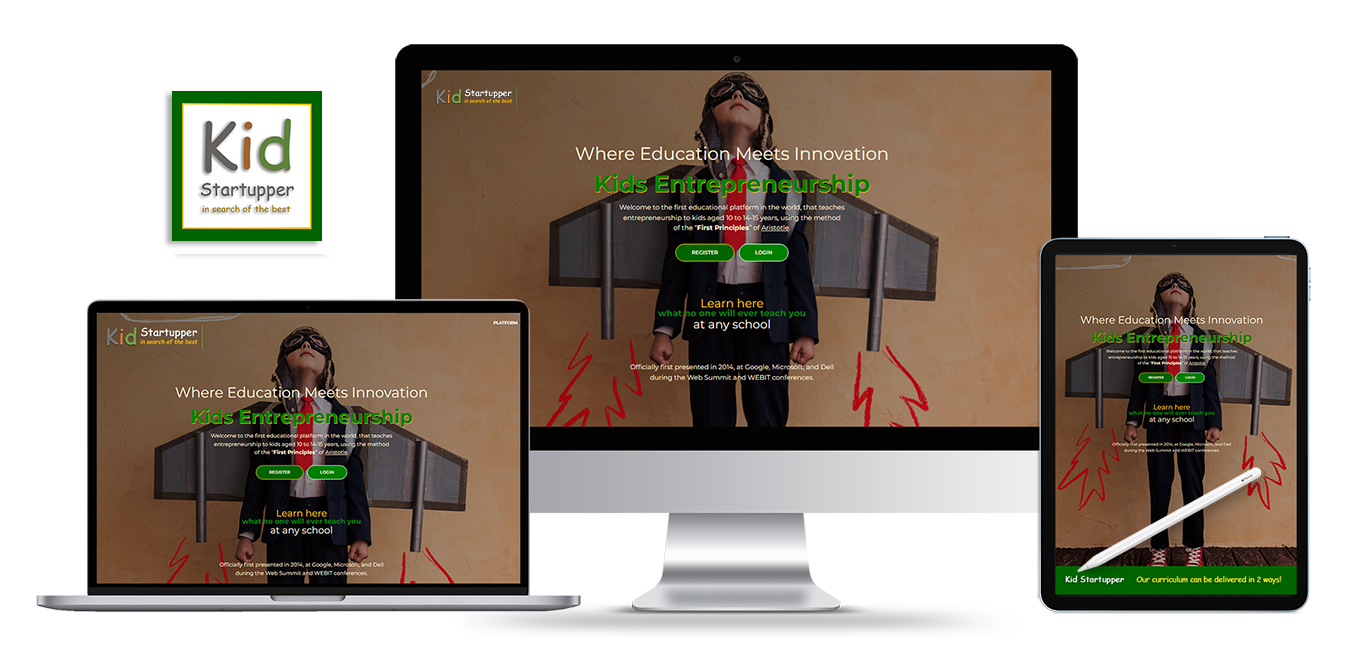
KidStartupper is structured around a three-year home programme built on Aristotle's First Principles methodology — a framework for reasoning from the ground up rather than by analogy to existing solutions. This approach was chosen specifically because it develops the kind of original, constraint-aware thinking that characterises strong entrepreneurial cognition.
Each year of the programme develops the capacities that the next year requires. Children do not move from lesson to lesson. They move from one stage of development to the next, with the programme's difficulty calibrated to remain at the productive edge of each child's current capability.
The programme combines structured conceptual learning with genuine creative projects, real audience presentations, financial reasoning in practical contexts, and collaborative challenges that require interdependence rather than task division. It has been recognised by Erasmus+, presented at Web Summit and Webit, and is used by schools and families across more than twenty countries.
If you want to understand what it produces for your child specifically, the most direct answer is available in our free seven-day trial. What you observe in that week will tell you more than any research summary.
start your child's free 7-day trial — no commitment, no credit card required
Frequently Asked Questions
What age is entrepreneurship education most effective for?
Research on cognitive development consistently identifies the 10 to 15 age window as particularly well-suited to developing the capacities that entrepreneurial thinking requires. Abstract reasoning, hypothetical thinking, and the ability to consider multiple perspectives simultaneously emerge and consolidate during this period. Habits of thought formed during this window are significantly more durable than those formed later in development. This is why KidStartupper focuses specifically on ages 10 to 15.
Does a child need to want to start a business to benefit from entrepreneurship education?
No. The capacities developed by entrepreneurship education — creative problem-solving, persuasive communication, resilience, decision-making under uncertainty, initiative — are valuable in every professional and personal context. Research consistently shows that these skills transfer across domains. Children who go on to careers in medicine, education, engineering, science, and the arts consistently report that entrepreneurial thinking skills have been among the most useful capacities they developed.
How does entrepreneurship education relate to academic performance?
Research on the relationship between entrepreneurship education and academic outcomes shows a consistent positive relationship, particularly in areas of reading comprehension, mathematical reasoning, and writing — all of which benefit from the cross-domain, communication-intensive nature of entrepreneurial learning. Entrepreneurship education is not a substitute for strong academic foundations. It is a complement that develops capacities academic education typically leaves underdeveloped.
How do you measure whether the learning is working?
The most reliable indicators are behavioural rather than test-based: increased willingness to attempt things the child is not already good at; increased persistence when something does not work immediately; increased comfort expressing and defending ideas; increased orientation toward "what can I do about this?" when encountering problems. Parents most commonly report these shifts within two to three months of consistent engagement, with the changes becoming more pronounced and durable over the full course of the programme.
You May Also Find These Articles Helpful
is an entrepreneurship course worth it for a 10-year-old?
what should parents look for in an online entrepreneurship program?