
Leadership Skills for Kids (And How Parents Can Build Them Naturally)
There is a moment I have seen play out dozens of times in group projects with children aged 10 to 15. The group has a task, a deadline and a disagreement about how to proceed. Someone needs to help everyone move forward.
Almost never is it the loudest child in the room.
It is usually the one who has been quietly listening. The one who waited until everyone had spoken, then said something like: "So what I'm hearing is that we want both things — what if we tried this?" Not because they were appointed leader. Not because they pushed hardest. But because they understood what the group needed and did something about it.
That child was demonstrating leadership in its most genuine form. And their parents would probably have been surprised — because at home, they were not particularly assertive or outgoing. They were just observant, thoughtful and willing to take responsibility when it mattered.
Leadership is one of the most misunderstood skills in childhood development. And because it is misunderstood, it is often either forced in the wrong direction — pushing shy children to "speak up more" — or ignored entirely in children who do not fit the loud, confident stereotype. Both are missed opportunities.
Here is what I have learned after twenty years of working with children in entrepreneurship education: leadership is not a personality type. It is a set of skills that develop through experience. And the home is one of the most powerful places to build them.
What Leadership Actually Means in Childhood
Most people, when they hear the word "leadership," picture a confident adult standing in front of a large group, speaking with authority. This image — while not wrong — is the end product of a long developmental process, not its starting point.
Leadership in childhood looks different. It looks like a ten-year-old who notices that a friend is being left out of a game and does something about it. A twelve-year-old who, during a group project, helps two teammates who disagree find common ground. A fourteen-year-old who takes on a responsibility no one asked them to take, sees it through and handles the complications that arise.
These moments are not dramatic. They do not involve stages or microphones. But they are where leadership is actually built — through small acts of initiative, responsibility, communication and care for others, repeated over time until they become habit.
What children who develop strong leadership skills learn to do is:
- take initiative without waiting for permission at every step
- make decisions and stand behind them while remaining open to feedback
- communicate ideas in a way that others can follow
- support the people around them rather than competing with them
- handle responsibility — including when things go wrong
None of these require a particular personality type. They require practice.
Why This Skill Matters More Than It Used To
In previous generations, a child could build a stable adult life through technical competence alone. Learn a skill, apply it reliably, advance gradually. That path still exists — but it is narrowing.
The skills that are becoming harder to replace — by technology, by automation, by artificial intelligence — are precisely the human ones. The ability to read a room. To motivate people who have lost momentum. To make a decision under uncertainty and take responsibility for it. To bring a group of very different individuals toward a shared goal.
These are leadership skills. And they do not develop in children who have never been given real responsibility, never been allowed to make meaningful decisions, never experienced what it feels like to take initiative and see what happens.
A child who reaches adulthood having only ever followed instructions is underprepared — not because they lack intelligence or knowledge, but because they have never had the experience of leading anything.
The Biggest Misunderstanding About Leadership
Let me be direct about something I see constantly in parent conversations: the assumption that quiet children are not natural leaders, and that the most talkative child in a group is the most likely to lead.
In my experience, the opposite is often true.
I once worked with a group of thirteen-year-olds on a project that required them to design and present a solution to a real problem. One student talked constantly — full of energy, confident, always the first to suggest something. Another student was much quieter. She spoke less than anyone else in the group, but when she spoke, it was always at a moment when the group was stuck. She would say something that reframed the situation, and the group would move forward.
By the end of the project, every other student in that group — without being asked — directed their questions to the quieter student. Not because she had asserted herself. Because she had earned their trust through consistent, thoughtful contributions over time.
That is what leadership actually looks like when it develops naturally. It is earned, not claimed. And it is available to children of every personality type — if they are given the right experiences.
Why Some Children Struggle to Develop Leadership Skills
Children who hesitate to take initiative or avoid responsibility are not lacking potential. They are usually lacking experience — or they have learned, through repeated early experiences, that taking initiative carries risk without reward.
Fear of failure. A child who has been corrected harshly for mistakes learns quickly that it is safer not to try. Leadership requires attempting things that might not work. A child who cannot tolerate that uncertainty will avoid leadership situations entirely.
Learned helplessness. When adults make every decision for a child — what to eat, what to wear, how to resolve every conflict, how to spend every afternoon — that child gradually loses confidence in their own judgment. They stop trusting their instincts because they have rarely had the chance to test them.
Comparison and criticism. A child who is constantly compared to a more confident sibling or classmate often internalises the message that they are "not a leader type." These labels, casually applied, can last for years.
Absence of real responsibility. Leadership does not develop in a vacuum. It develops through actual experience of being responsible for something — and experiencing the consequences, positive and negative, of how you handle it. Children who have never had this have no foundation to build on.
How Parents Can Build Leadership Skills at Home
1. Give Children Real Responsibilities — Not Symbolic Ones
There is a difference between a child who is asked to "help" with something an adult is managing, and a child who is genuinely responsible for something. The first is an assistant. The second is developing leadership.
Real responsibility means the child owns the outcome. If they are responsible for the family's plans for Sunday afternoon, they are responsible for finding out what everyone wants, making a proposal, handling the logistics and dealing with what happens if something goes wrong. Not with adult backup at every step — with guidance available if needed, but genuine ownership of the task.
Start small. A ten-year-old can be genuinely responsible for planning one family meal per week — including deciding what to cook, making sure the ingredients are available and preparing it with whatever supervision is appropriate. That experience teaches more about leadership than any number of conversations about it.
2. Let Children Make Decisions and Live With the Results
One of the most difficult things for many parents to do is to let a child make a decision they believe is wrong — and then not intervene when the predictable consequence arrives.
I am not talking about situations with serious consequences. I am talking about the everyday decisions that carry small but real stakes: how to spend free time, how to approach a school project, how to resolve a disagreement with a friend.
A child who decides to leave a project until the last minute and then has a stressful evening finishing it has learned something that no lecture about time management could teach. A child who chooses to handle a friendship conflict in a way that backfires has gained direct experience of cause and effect in social situations.
These experiences, allowed to play out without adult rescue, are the raw material of good judgment. A child who never makes real decisions never develops it.
3. Ask Questions Instead of Giving Answers
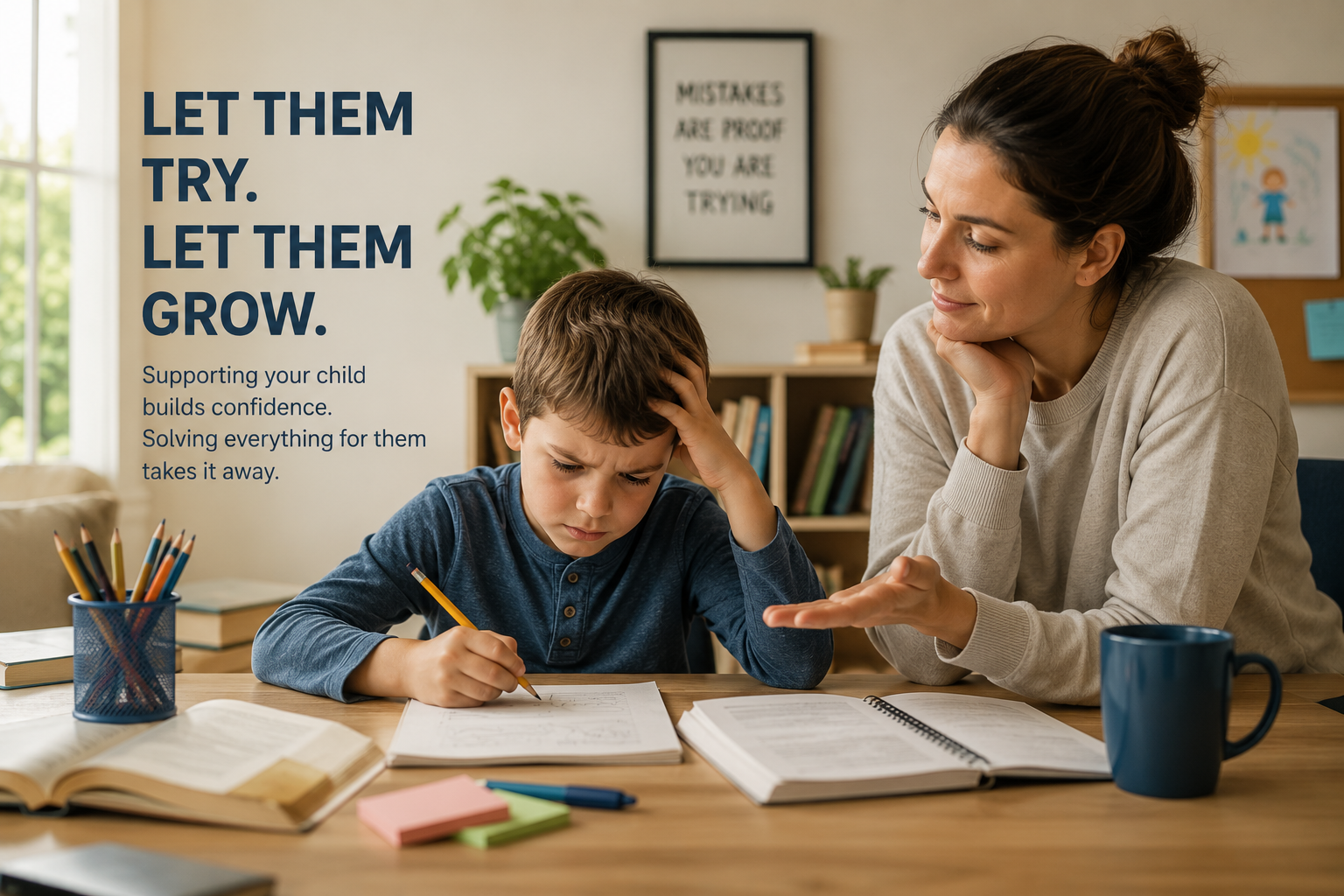
When a child comes to you with a problem, the instinct is to solve it. This is natural and comes from care. But it consistently deprives the child of the experience of solving things themselves.
A simple shift: before offering a solution, ask one question. "What do you think you could do?" Or: "What have you already tried?" Or simply: "What do you need to figure this out?"
These questions do two things. They communicate that you believe the child is capable of working toward a solution — which is itself a powerful message. And they create the cognitive experience of actually working toward one, which is where the skill develops.
You will often find that children, given a moment to think without an adult rushing to help, arrive at reasonable solutions on their own. When they do, resist the urge to improve upon it. Let it be their solution.
4. Reframe Mistakes as Information
Children who fear failure avoid the situations where leadership develops. They do not volunteer for things that might not work. They do not take initiative when the outcome is uncertain. They wait — for instructions, for permission, for certainty that never arrives.
The way a family treats mistakes has an enormous effect on this. Not through explicit lessons, but through the tone of everyday responses. When something goes wrong, is the first response criticism, or curiosity? "What were you thinking?" sends a very different message than "What happened, and what would you do differently?"
I have worked with children who could not tell me a single thing they had tried that had not worked, because they had been so well protected from failure that they had never really risked anything. These children were not confident — they were fragile. Their self-image depended entirely on succeeding, which meant they could not afford to try anything genuinely difficult.
Leadership requires the ability to try, fail, learn and try again. That ability is built at home, long before any formal challenge.
5. Create Genuine Opportunities for Teamwork
Leadership does not develop in isolation. It develops in the context of other people — through the experience of working toward a shared goal with individuals who have different ideas, different strengths and different priorities.
This does not require organised activities. It happens whenever children work together on something real: planning an event, building something, solving a problem that affects more than one person. What matters is that the collaboration is genuine — that each person's contribution actually affects the outcome, and that disagreements need to be navigated rather than decided by an adult.
Pay attention to what happens when things get difficult. Does your child withdraw? Push harder? Look for compromise? Each of these responses tells you something about where their leadership development currently is — and gives you something concrete to work with.
6. Teach Empathy as a Leadership Skill
This one is consistently underestimated. Parents and educators focus heavily on confidence, communication and decision-making — all important. But the leadership quality that I have seen make the most difference in children working together is empathy: the ability to understand what someone else is experiencing and respond to it appropriately.
A child who can read that a teammate is frustrated, and knows how to acknowledge that without dismissing the work, is more effective in a group than a child who is more confident but oblivious to the people around them.
Empathy develops when children are regularly asked to consider perspectives other than their own. After a conflict: "What do you think they were feeling when that happened?" After a group activity: "Who do you think found that most difficult, and why?" These questions, asked consistently, build a habit of attention to others that underpins every other leadership skill.
7. Let Children Lead Something They Actually Care About
The most effective leadership development happens when a child is genuinely invested in the outcome. A forced leadership role in an activity a child finds meaningless teaches very little. A real ownership role in something they care about teaches an enormous amount.
This might be planning a trip they are excited about. Organising a project with friends around something they love. Taking charge of a family decision that genuinely affects them. The content matters less than the authenticity of the ownership. When a child actually cares whether something succeeds, they bring a quality of engagement that no external motivation can replicate — and that engagement is where real learning happens.
Leadership Shows Up in Small Moments
It is easy to imagine leadership development as something that happens in structured programs, competitions or formal settings. And those can help. But the most formative leadership experiences I have observed in children happened in much quieter moments.
A child who noticed that a classmate was struggling and offered to help — without being asked. A child who, during a family dinner, suggested a solution to a problem that had been worrying the adults. A child who took responsibility for a mistake that affected someone else and worked to make it right.
None of these required courage in the dramatic sense. They required attention, care and the willingness to do something. That willingness is what leadership, at its core, actually is.
How Leadership Connects with Entrepreneurial Thinking
In the work I do with children through structured entrepreneurship education, leadership is not a separate topic — it is woven through everything. When children work on real projects, present ideas, navigate disagreements and take responsibility for outcomes, they are practising leadership constantly.
The connection is not coincidental. Entrepreneurial thinking requires exactly the same qualities: initiative, resilience, communication, the ability to bring others along toward a shared vision. A child who develops one develops the foundation for the other.
You can explore more on these related topics here:
problem solving activities for kids
Questions Parents Often Ask
Can shy children become strong leaders?
Not only can they — they often do. Shyness and leadership are not opposites. Some of the most effective leaders I have worked with were children who spoke less than their peers but listened more carefully, thought more deliberately and acted with more consideration. The quality of what a person contributes matters far more than the quantity.
At what age should parents start thinking about leadership development?
Earlier than most parents assume. The habits that underpin leadership — taking small initiatives, making age-appropriate decisions, handling minor responsibilities — can and should begin in early childhood. By the time children reach 10 to 15, the foundations are already being set. What changes at this age is the complexity and stakes of the opportunities available to them.
Should parents push children into leadership roles?
No — and this is important. Pressure produces performance anxiety, not genuine development. What parents can do is create conditions: give real responsibility, ask questions instead of providing answers, allow natural consequences, celebrate initiative. Leadership grows in those conditions. It does not grow under pressure.
What if my child simply does not seem interested in leading anything?
Look more carefully. Children who appear uninterested in leadership are often very interested in specific things — and within those things, they frequently show exactly the qualities you are looking for. A child who organises their friends during a game, who takes charge of how a creative project comes together, who advocates firmly for what they believe is fair — these are all leadership moments, even if they do not look like what adults imagine leadership to be.
Final Thoughts
Leadership is not a destination. It is a direction — a set of habits and qualities that develop gradually through the accumulation of experiences where a child was trusted, given responsibility and supported in handling whatever came next.
The children who grow into genuinely capable leaders are almost never those who were pushed into the role or told they were natural leaders. They are the ones who had enough real experience — of making decisions, of helping others, of taking initiative and seeing what happened — to develop a quiet confidence in their own ability to contribute.
That confidence does not come from praise. It comes from evidence. From a child's own experience of having tried something difficult and found that they could handle it.
Your role as a parent is not to produce a leader. It is to create the conditions in which one can develop — by trusting your child with things that matter, stepping back enough to let them figure things out and being present when they need support.
Start this week with one small thing. Give your child a responsibility they have not had before. Do not manage it for them. See what they do with it.
If you want your child to develop leadership, communication and entrepreneurial thinking through structured, project-based lessons designed for ages 10 to 15, you can learn more about the programme here:
entrepreneurship lessons for kids from home