
How to Teach Kids Problem Solving Skills (A Practical Guide for Parents)
Every parent has experienced a moment like this.
Your child comes to you frustrated.
Maybe it’s homework they don’t understand. Maybe a disagreement with a friend. Maybe something broke in their project or game and they don’t know what to do next.
The instinct of most parents is immediate:
solve the problem for them.
We explain the answer. We fix the situation. We give the solution.
But something important happens when we do this repeatedly.
The child learns that when a problem appears, someone else will solve it.
Instead of learning how to think through challenges independently, they begin relying on external answers.
Yet problem solving is one of the most important abilities a child can develop.
It affects how they approach school, relationships, creativity, future careers and everyday life decisions.
The good news is that problem solving is not something children either “have” or “don’t have.”
It is a skill that can be practiced.
And often, the best opportunities to practice it appear in ordinary everyday situations.
Why Problem Solving Is One of the Most Important Skills for Children
In the past, education focused heavily on memorization.
Students learned facts, formulas and information.
While knowledge is still valuable, the world children are growing up in today is very different.
Technology evolves quickly, information is available everywhere and many future jobs will require flexible thinking rather than memorized answers.
Because of this, educators increasingly emphasize problem solving as a core skill.
Children who learn to approach problems calmly and creatively tend to:
- adapt better to challenges
- develop stronger confidence
- think independently
- handle frustration more effectively
- generate original ideas
These qualities are closely connected with innovation, leadership and entrepreneurial thinking.
What Problem Solving Looks Like in Real Life
Problem solving does not begin with complex math problems or scientific experiments.
It begins with simple everyday situations.
For example:
A 12-year-old forgets their homework notebook at school.
Instead of immediately solving the situation, a parent might ask:
“What do you think we could do about this?”
The child might suggest several possibilities:
- call a friend and ask for the homework
- write an email to the teacher
- recreate the assignment from memory
The important part is not which solution is chosen.
The important part is that the child begins thinking through the options.
This is how problem solving develops.
Situation #1: When Homework Feels Impossible
One of the most common situations parents encounter is homework frustration.
A child sits at the table, looks at a difficult exercise and quickly says:
“I can’t do this.”
Instead of immediately explaining the answer, try guiding the process.
You might ask:
- What part of the question do you understand?
- What part feels confusing?
- What could be the first small step?
This approach helps children break a large challenge into smaller steps.
It teaches them that problems rarely need to be solved all at once.
Situation #2: Conflict With Friends
Children often encounter social challenges.
A friend may say something upsetting or a disagreement might occur during a game.
Parents sometimes feel tempted to intervene immediately.
However, these moments are powerful opportunities for learning.
You might ask your child:
- What do you think your friend was feeling?
- What could you say to solve the problem?
- What would you want someone to say to you in that situation?
These questions encourage empathy and perspective-taking, both essential for problem solving.
Situation #3: A Broken Project
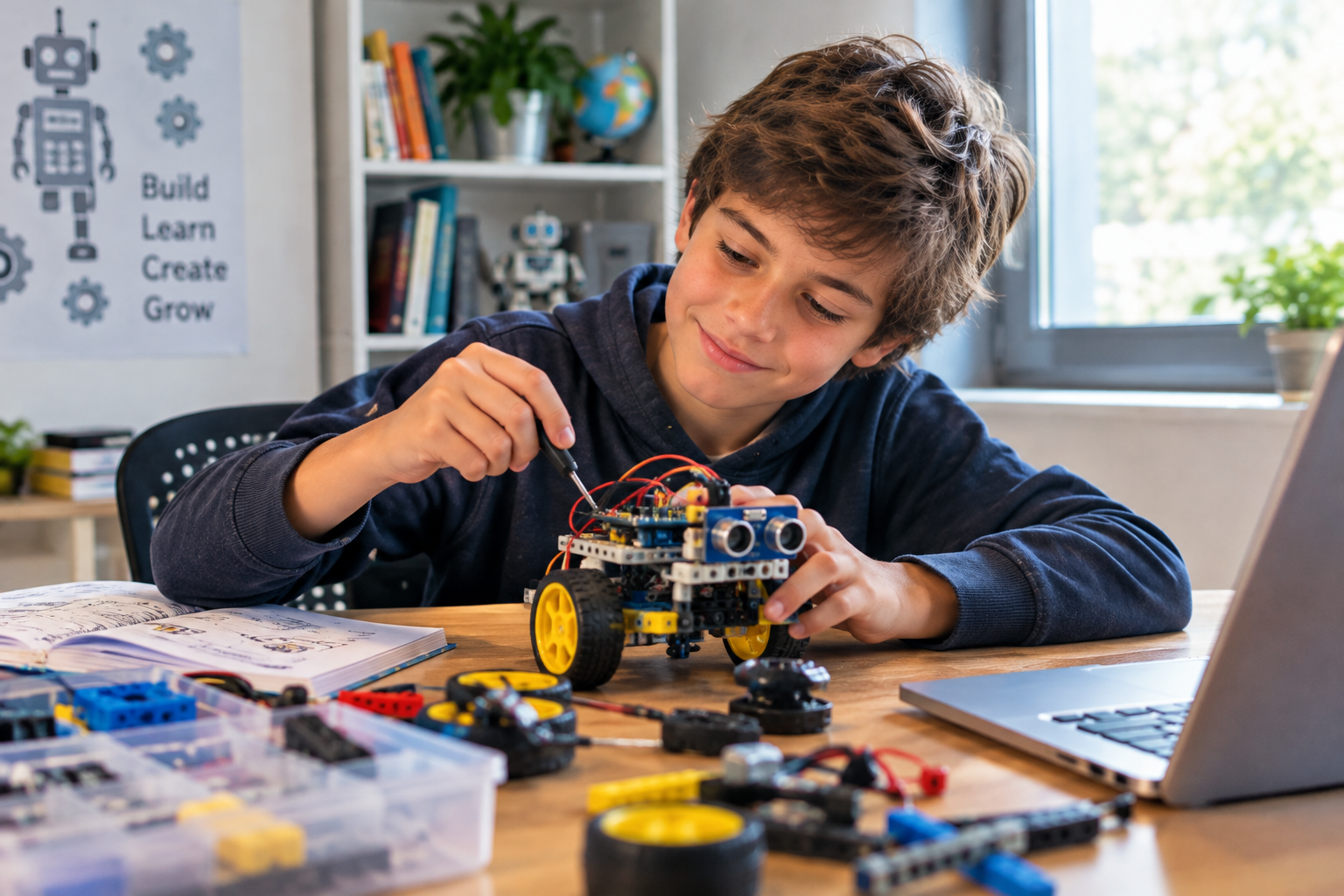
Imagine a child building something for school: a model, craft or science project.
Suddenly part of it breaks.
The child becomes frustrated and says the entire project is ruined.
This moment is a perfect example of problem solving in action.
A parent might say:
“If an engineer or inventor had this problem, what do you think they would try next?”
The child may begin brainstorming alternatives:
- reinforce the structure
- replace a part
- redesign the project
Now the problem becomes an experiment instead of a failure.
Situation #4: Everyday Family Problems
Problem solving does not need to happen only in academic situations.
Simple family challenges can be great learning opportunities.
For example:
The family kitchen is often messy after dinner.
Instead of assigning chores immediately, a parent might ask:
“How could we organize dinner cleanup better?”
Children might suggest:
- a rotating responsibility system
- creating a checklist
- using a timer to turn cleanup into a challenge
Now the child is participating in designing solutions.
Why Asking Questions Is More Powerful Than Giving Answers
One of the most powerful tools parents have is simply asking thoughtful questions.
Questions encourage children to explore possibilities instead of searching for a single correct answer.
Helpful questions include:
- What do you think we could try?
- What might happen if we tried that?
- What is another possible solution?
- What could we learn from this?
Over time, children begin asking themselves these same questions internally.
This is when independent problem solving truly develops.
Problem Solving and Creative Thinking
Problem solving is closely connected with creativity.
Creative thinking allows children to imagine possibilities beyond the obvious solution.
For example, when children invent games, design projects or create new ideas, they are practicing flexible thinking.
If you want practical exercises that encourage creativity and innovation, you may also find our guide helpful:
creative thinking activities for kids
Turning Problem Solving Into Real Projects
As children grow older, problem solving often leads naturally into innovation and entrepreneurial thinking.
For example:
A child who notices that classmates struggle to organize homework might imagine a better planner.
A student who sees younger kids bored during recess might invent a new playground game.
Another child might notice that school backpacks are uncomfortable and design a new layout.
These are the beginnings of entrepreneurial thinking.
Children learn that problems can lead to ideas, and ideas can become solutions.
Helping Children Explore Problem Solving Through Structured Learning
Many parents want to help their children develop these abilities but sometimes feel unsure how to guide the process consistently.
Structured learning environments can provide helpful support.
Programs that encourage children to:
- identify problems
- develop ideas
- design projects
- present their solutions
can significantly strengthen problem solving and creative thinking.
If you want your child to explore innovation and entrepreneurship through guided activities, you can learn more about the program here:
entrepreneurship lessons for kids from home
KidStartupper introduces students ages 10–15 to creative thinking, startup ideas and real-world problem solving through interactive lessons, projects and challenges.
Final Thoughts
Children do not develop strong problem solving skills by always receiving the answer.
They develop it by exploring possibilities.
When parents shift from solving problems to guiding thinking, something powerful happens.
Children begin to trust their own ideas.
They learn that challenges are not obstacles but opportunities to think, experiment and improve.
And this mindset can influence the way they approach learning, creativity and the future.