Creative Thinking Activities for Kids (Ages 10–15) That Build Real-World Skills
I have spent almost twenty years in rooms full of kids aged 10 to 15, and I want to tell you something that took me years to fully understand.
The most creative child in the room is almost never the "talented" one.
It is usually the one who feels safe enough to say a "stupid" idea out loud. The one who is not afraid to be wrong in front of everyone.
That is the real secret of creative thinking. It is not a gift a few children are born with. It is a muscle. And like any muscle, it grows when you use it, and it weakens when you sit still.
In a world where technology changes every few months and entire careers appear and disappear inside a single decade, the children who will do well are not the ones who memorize the most. They are the ones who can look at a problem nobody has solved yet and think, "Okay, let me try something."
The activities below are not theory. They are the exact kinds of exercises I have run with real children, watched fail, fixed, and run again. I am going to give them to you the way I would explain them to a parent sitting across from me, with the small details that actually make them work.
Why Creative Thinking Is Important for Kids
School trains a very specific skill: find the one correct answer the teacher already knows.
That skill matters. But it is only half of what your child needs. Real life rarely hands you a problem with one right answer printed at the back of the book.
Creative thinking teaches a child the opposite reflex. Instead of asking "What is the answer?", they learn to ask "How many answers can I find, and which one is best?"
When a child practices this regularly, a few things start to change in a way you can actually see at home:
- Problem-solving: they stop freezing when something is hard and start breaking it into smaller pieces.
- Confidence: they learn that a "wrong" idea is not a failure, it is information.
- Curiosity: they begin asking better questions instead of waiting to be told what to do.
- Innovation mindset: they notice problems most people walk past every day.
- Entrepreneurial thinking: they start turning "I have an idea" into "I built something."
That last one is the whole reason I built KidStartupper. The gap between a child who has ideas and a child who can build them is enormous, and almost no school closes it.
15 Creative Thinking Activities for Kids
A quick note before you start. The goal is never a perfect result. The goal is the thinking. If your child produces something messy and full of holes but they fought for the idea, that is a win. Praise the effort and the thinking, not the polish.
1. Invent a New Product
Ask your child to find a small, annoying problem from their own day and invent a product that fixes it.
The trick is to make it personal. When I tell a group "invent something useful," I get blank stares. When I say "What is the most annoying thing that happened to you this week?", the room comes alive.
One boy in a session of mine was furious that his earphones were always tangled in his bag. By the end of the hour he had sketched a phone case with a built-in cord channel. Was it realistic? Not entirely. Did he just experience the entire creative process from frustration to solution? Absolutely.
- Skill it builds: turning a complaint into an opportunity.
- Parent tip: do not fix the flaws in their idea. Ask "What would make it even better?" and let them fix it.
2. Create a Mini Business Idea
Children can brainstorm small businesses they could realistically try in their own neighborhood, not a fantasy company with a billion dollars.
Keep it close to home. A weekend dog-walking service. Custom-painted phone cases for classmates. A "tech helper" service for grandparents in the building who cannot set up their phones. The constraint of "something you could actually start this month" forces sharper thinking than "any business in the world."
If you want a ready list to spark this one, read our guide on business ideas for kids together and let your child react to which ones they would change.
- Skill it builds: spotting demand close to home.
- Parent tip: ask "Who exactly would pay for this, and why?" It teaches them to think about a customer, not just an idea.
3. Design a New Game
Have your child invent a board game or a playground game with their own rules, scoring and challenges.
This one looks like play, but it is secretly systems design. To make a game fun, a child has to balance difficulty, reward and fairness. I have seen 12-year-olds argue about whether a rule is "too overpowered" with the seriousness of game studio designers, and that is exactly the point.
- Skill it builds: designing rules and balancing a system.
- Parent tip: actually play the broken first version with them. When it breaks, they learn to redesign.
4. Build Something From Recycled Materials
Give them cardboard boxes, plastic bottles, paper rolls and tape, and a single challenge: build something useful.
Limited materials force more creativity, not less. When a child can use anything, they freeze. When they only have a shoebox and three bottle caps, they get inventive fast. This is the constraint principle, and professional designers use it every day.
- Skill it builds: resourcefulness and working within limits.
- Parent tip: resist buying extra supplies. The "not enough" is doing the teaching.
5. Solve a Real-Life Problem
Ask your child to walk through a normal day and write down every small thing that does not work well.
Then pick one and solve it. Some starters that always get kids going:
- How could we organize the school bags by the door so nobody forgets anything?
- How could we waste less food at home each week?
- How could homework feel less boring?
This is the most important activity on this entire list. Why? Because creativity that solves a real problem is the foundation of every business and every invention that has ever existed. You are teaching them to look at the world as something they are allowed to fix.
- Skill it builds: noticing problems instead of accepting them.
- Parent tip: let them solve a problem that annoys you. Their solution being used for real is incredibly motivating.
6. Create a Story From Random Words
Write five completely unrelated words on small papers, for example "submarine, banana, Tuesday, magnet, grandmother," and ask them to build one story that uses all of them.
Forcing unrelated ideas to connect is the core mechanic of creativity. The brain has to build a bridge between things that do not belong together, and that bridge-building is exactly the skill we want to train.
- Skill it builds: connecting unrelated ideas.
- Parent tip: make it harder by adding a sixth word halfway through. The forced adaptation is great practice.
7. Design a Future City
Ask them to imagine their own town in 50 years and draw it: the buildings, the transport, the technology, how people live.
Future-thinking pulls children out of "how things are" and into "how things could be." That mental shift is what separates someone who accepts the world from someone who reshapes it.
- Skill it builds: imagining beyond current limits.
- Parent tip: ask "What problem does this future fix that we have today?" to keep it grounded, not just sci-fi.
8. Create a New App Idea
Most kids this age live on apps. Flip them from users into designers.
Ask: what app does not exist yet that would actually help students, parents or teachers? Push past "a game." A homework reminder that sends a meme when you finish. An app that swaps unused craft supplies between neighbors. The point is not to code it. The point is to think about who it serves and why they would open it twice.
- Skill it builds: designing for a user, not for themselves.
- Parent tip: ask them to "sell" the app to you in 30 seconds. That tiny pitch is real entrepreneurial training.
9. Reverse Thinking Challenge
Instead of asking how to make something better, ask how to make it as bad as possible.
"How would you design the worst possible classroom?" Kids love this, and they go wild. Then comes the magic move: take their list of awful ideas and flip each one. Suddenly they have designed an excellent classroom without even noticing, and they understand the problem far more deeply than if you had asked directly.
- Skill it builds: understanding a problem from the opposite direction.
- Parent tip: always finish by flipping the bad ideas into good ones. That is where the learning lands.
10. Design a Logo
If your child likes drawing, have them design logos for imaginary companies, a space pizza chain, a robot repair shop, a sneaker brand.
A logo forces a child to compress an entire idea into one simple symbol. That is hard, focused thinking disguised as art, and it teaches them that good design means saying a lot with very little.
- Skill it builds: communicating an idea simply and visually.
- Parent tip: ask "What should someone feel when they see this?" to connect design to emotion.
11. Create a YouTube Channel Idea
Have them plan a channel they would genuinely enjoy making: science experiments, gaming tips, sneaker reviews, whatever they love.
The thinking here is real strategy. Who is the audience? What makes this channel different from the thousand others? What would the first five videos be? You are teaching positioning and audience-building, the same skills any creator or founder needs, wrapped in something they already care about.
- Skill it builds: thinking about an audience and standing out.
- Parent tip: they do not need to film anything. Planning the idea is the whole exercise.
12. Build a Prototype
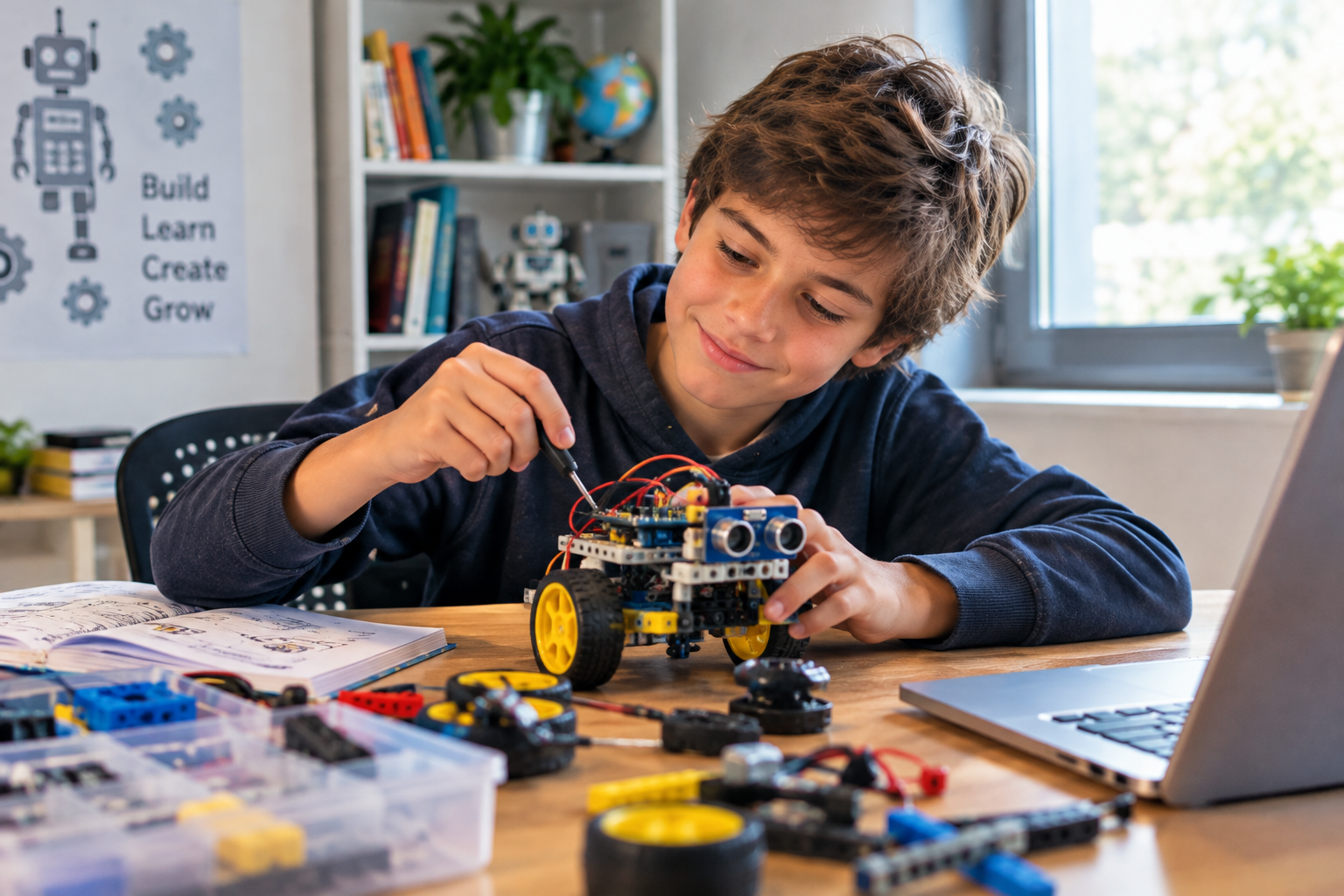
If your child has an invention idea, do not let it stay an idea. Help them build a rough, ugly model out of whatever is around the house.
This is the single biggest lesson I teach, and the one schools skip entirely. There is a giant difference between a child who says "I have an idea" and a child who holds a wobbly cardboard version of it in their hands. The first is a dreamer. The second is becoming a builder. That shift changes how a child sees themselves.
- Skill it builds: turning an idea into something real.
- Parent tip: celebrate the ugly first version loudly. "First versions are supposed to be bad" is a phrase that frees children.
13. Brainstorm 10 Uses for One Object
Put a single ordinary object on the table, a pencil, a paperclip, a brick, and ask for ten different uses.
The first three are easy. Uses four through ten are where the actual creative work happens, because the obvious answers are gone and the brain has to stretch. Push them past the point of "I am out of ideas." That is exactly where creativity lives.
- Skill it builds: fluency, generating many ideas instead of stopping at one.
- Parent tip: when they say "I am done," ask for just three more. The forced extra round is the most valuable part.
14. Create a Comic Story
Children who like drawing can invent their own characters, world and storyline as a short comic.
A comic combines so many creative skills at once: character design, story structure, dialogue, problem and resolution. It also gives quieter, less verbal children a way to express big ideas without having to stand up and present.
- Skill it builds: storytelling and combining ideas into one world.
- Parent tip: ask "What does your main character want, and what is stopping them?" Every good story needs that tension.
15. Design a Small Event
Let your child plan a real, small event: a family game night, a neighborhood activity, a themed dinner.
This one quietly teaches project management. There is a budget, a schedule, supplies, people to invite, and things that go wrong. When a child plans an event and then actually runs it, they get a complete cycle of idea to execution, which is rare and incredibly valuable at this age.
- Skill it builds: planning and executing a real project end to end.
- Parent tip: let them handle a small real budget. Real money makes the decisions real.
How Parents Can Encourage Creative Thinking
You do not need to be creative yourself to raise a creative child. You mostly need to get out of the way at the right moments.
After two decades of this, here is what actually moves the needle:
- Reward questions, not just answers. When your child asks something strange, lean in instead of rushing to explain. Curiosity that gets attention grows.
- Let them be wrong on purpose. A child who is terrified of mistakes will never take a creative risk. Make your home a place where a bad idea is welcome.
- Praise the thinking, not the result. "I love how you figured that out" builds a creator. "That is so pretty" builds a child who only chases approval.
- Protect boredom. Constant screens and scheduled activities leave no empty space, and creativity is born in empty space. A bored child eventually invents something.
- Give them time, not just tools. An expensive kit used for ten rushed minutes is worth less than a cardboard box and an unhurried afternoon.
The biggest mistake I see loving parents make is fixing things too fast. When your child struggles with an idea, the struggle is the lesson. Sit on your hands a little longer than feels comfortable.
From Creative Ideas to Real Projects
Here is the hard truth I learned the slow way.
Most children are full of ideas. Very few ever learn how to turn an idea into a finished thing. And that single skill, finishing, is what eventually separates the adults who build careers, companies and real work from the ones who spend their whole lives saying "I had that idea first."
The activities above are the spark. But a spark on its own goes out. What children need next is a structure that takes them from "I thought of something" all the way to "I built it, I tested it, and I made it better."
That is exactly the gap I built KidStartupper to fill. We use a method based on Aristotle's First Principles, the same way of thinking behind founders like Musk and Jobs, broken down into steps a 10 to 15 year old can actually follow. Children do not just brainstorm. They build, present, get feedback and improve, with an AI mentor guiding them the whole way.
If you want to see how your child can take their creativity from random ideas to real, finished projects, you can explore the programme here:
entrepreneurship lessons for kids from home
And if you want to go one layer deeper into the specific skills this age group needs most, read entrepreneurial skills kids should learn before age 15.
Final Thoughts
Creative thinking is not about art, and it is not a personality type your child either has or does not have.
It is the ability to look at the world, see what could be better, and have the confidence to try. It is the most future-proof skill there is, because no matter how much technology changes, the world will always need people who can imagine what does not exist yet and build it.
You do not need a special program to start. Pick one activity from this list and try it this week. Keep it light, keep it fun, and praise the effort harder than the result.
The children who learn to think creatively early grow into adults who do not wait for permission to create. That is the gift, and it starts at your kitchen table.